Are You Writing the Right Reminder Email? Answering All the Important Questions

Ayesha Ejaz Last updated on

A reminder email seems simple on the surface. You are nudging someone to take action; pay an invoice, attend a meeting, respond to a message, or show up to an event. But in practice, writing an effective reminder email requires timing, tone, structure, and clarity.
Send it too soon and you risk sounding impatient. Send it too late and you lose momentum. Make it too direct and it feels aggressive. Make it too soft and it gets ignored.
This guide answers every important question about writing a reminder email. You’ll learn what reminder emails are, why they matter, what to include, when to send them, and how to use ready-to-adapt templates for payments, meetings, appointments, follow-ups, webinars, surveys, and events.
If you want higher response rates without damaging relationships, this is the framework to follow.
What Are Reminder Emails?
A reminder email is a follow-up message sent to prompt the recipient to complete an action, respond to communication, or remember an upcoming commitment.
It can apply to many business situations:
- A payment reminder email for unpaid invoices
- A professional meeting reminder email template for scheduled discussions
- An appointment reminder email template for consultations
- An event reminder email for conferences or webinars
- A gentle reminder email for no response
- A survey reminder email
- A webinar reminder email
In short, reminder emails bridge the gap between intention and action.
They are not complaints. They are not accusations. They are structured nudges that keep workflows moving.
Why Are They So Important?
Reminder emails serve a strategic function in operations, sales, customer success, and marketing.
| # | Key Benefit | Explanation |
|---|---|---|
| 1 | They Protect Revenue | Unpaid invoices, missed renewals, and forgotten payments directly impact cash flow. A professional payment reminder email template ensures you recover revenue without harming relationships. Even a single invoice reminder email can significantly reduce payment delays. |
| 2 | They Reduce No-Shows | An appointment reminder email or meeting reminder email template prevents calendar confusion and lowers cancellation rates. This is critical for service businesses where time equals revenue. |
| 3 | They Increase Engagement | Event reminder emails and webinar reminder emails boost attendance rates. People intend to join — they just forget. |
| 4 | They Drive Conversions | A follow-up reminder email can revive stalled conversations, pending approvals, or incomplete sign-ups. |
| 5 | They Maintain Professionalism | Knowing how to send a friendly reminder email demonstrates organization and accountability. It signals that your time and processes matter. |
What Goes in a Reminder Email?
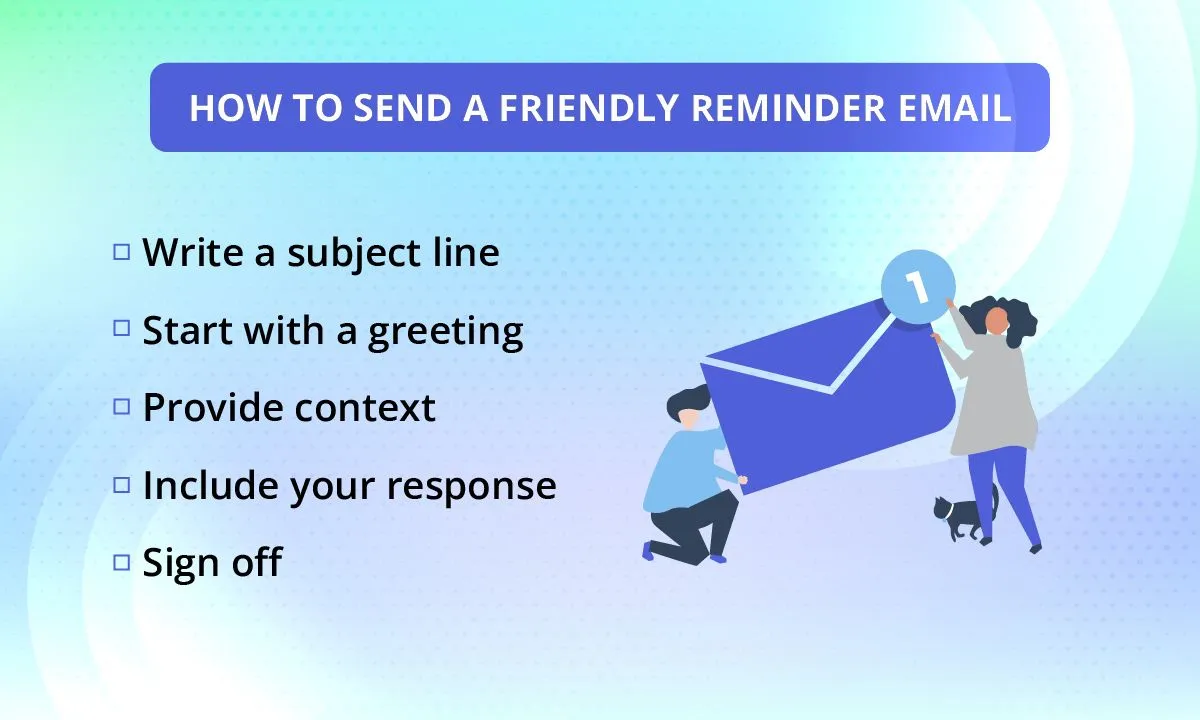
An effective reminder email has five essential components. Each plays a distinct role in driving action.
Subject Line
Your subject line determines whether the email gets opened.
It should be:
- Clear
- Specific
- Action-oriented
- Concise
Examples:
- “Reminder: Invoice #1024 Due Today”
- “Friendly Reminder: Meeting Tomorrow at 3 PM”
- “Appointment Reminder – March 5”
- “Webinar Reminder: Starts in 2 Hours”
Avoid vague lines like “Just Checking In.” Specificity improves open rates and reduces confusion.
What’s Coming
Open with context immediately. The reader should understand why they’re receiving the email within the first sentence.
Example:
“I’m writing to remind you that invoice #1024, sent on February 15, is due on March 1.”
Clarity reduces friction. Never assume the recipient remembers the prior message.
Greetings
Tone matters. The right greeting sets the emotional temperature.
For a friendly reminder email:
“Hi Sarah,”
For a more formal professional reminder:
“Dear Mr. Ahmed,”
For a gentle reminder email:
“I hope you’re doing well.”
Match tone to relationship. A payment reminder email sample for a long-term client will differ from one sent to a first-time customer.
Important Details
This is the functional core of your reminder email template.
Include:
- Dates
- Amounts (if applicable)
- Meeting time and location
- Links or attachments
- Reference numbers
- Clear call to action
For example:
“Your appointment is scheduled for March 5 at 11:00 AM at our Clifton office. Please confirm your attendance by replying to this email.”
The goal is precision. Avoid ambiguity.
Something Extra
This section softens the reminder and encourages action.
It can include:
- A thank-you
- An offer to help
- A payment link
- A reschedule option
- A polite closing statement
Example:
“If you’ve already made the payment, please disregard this message.”
This single sentence prevents friction in payment reminder email communication.
When to Send a Reminder Email
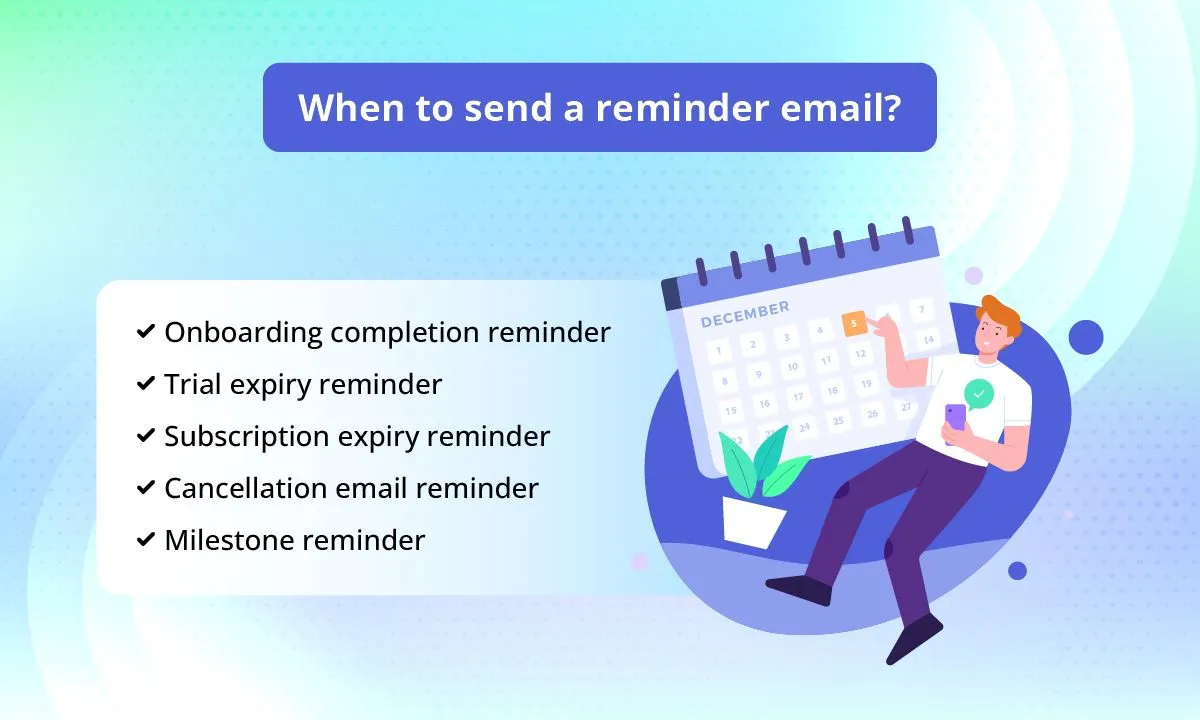
Timing determines effectiveness.
Payment Reminder Email Timing
- 3–5 days before due date
- On due date
- 3–7 days after due date
- 14 days overdue
- 30 days overdue
Escalation should be gradual. Early reminders should be friendly. Later ones can be firmer but remain professional.
Appointment Reminder Email Timing
- 48 hours before appointment
- 24 hours before appointment
- 2–3 hours before (optional SMS or short email)
This dramatically reduces no-shows.
Meeting Reminder Email Timing
- 24 hours before
- 1 hour before (for virtual meetings)
Include the meeting link clearly.
Event Reminder Email Timing
For conferences or webinars:
- One week before
- One day before
- One hour before
A webinar reminder email especially benefits from multiple touchpoints.
Gentle Reminder Email for No Response
If someone has not replied:
- First follow-up: 3–5 business days
- Second follow-up: 7–10 business days
- Final follow-up: 2 weeks later
Space matters. Do not overwhelm.
User-Friendly Reminder Email Templates
Below are structured templates you can adapt.
Payments and Invoices
Subject: Reminder: Invoice #1024 Due March 1
Hi [Name],
This is a friendly reminder that invoice #1024 for $2,500 is due on March 1.
You can complete the payment using the link below:
[Payment Link]
If you’ve already processed the payment, please disregard this email. Let me know if you need any clarification.
Thank you,
[Your Name]
This professional payment reminder email template is clear, polite, and actionable.
Appointments
Subject: Appointment Reminder – March 5 at 11:00 AM
Hi [Name],
Just a quick reminder about your appointment scheduled for March 5 at 11:00 AM at our Clifton office.
If you need to reschedule, please let us know at least 24 hours in advance.
Looking forward to seeing you.
Best,
[Your Name]
This appointment reminder email template reduces confusion and last-minute cancellations.
Deadlines
Subject: Reminder: Proposal Submission Due Friday
Hi [Name],
This is a reminder that the proposal submission deadline is Friday, March 8.
Please ensure all required documents are submitted before 5:00 PM.
Let me know if you need any assistance.
Regards,
[Your Name]
Clear deadline communication prevents operational bottlenecks.
Follow-Up
Subject: Gentle Reminder: Awaiting Your Feedback
Hi [Name],
I wanted to follow up on my previous email regarding the marketing proposal shared on February 20.
When you have a moment, I’d appreciate your feedback.
Please let me know if you need additional details.
Thank you,
[Your Name]
This gentle reminder email for no response keeps the conversation professional and respectful.
Event Reminders
Subject: Webinar Reminder: Starts Tomorrow at 2 PM
Hi [Name],
We’re excited to see you at tomorrow’s webinar, “Optimizing Email Automation.”
Date: March 6
Time: 2:00 PM
Join Here: [Link]
Add it to your calendar so you don’t miss it.
See you there,
[Your Name]
A webinar reminder email should include time, date, and link prominently.
Common Mistakes to Avoid
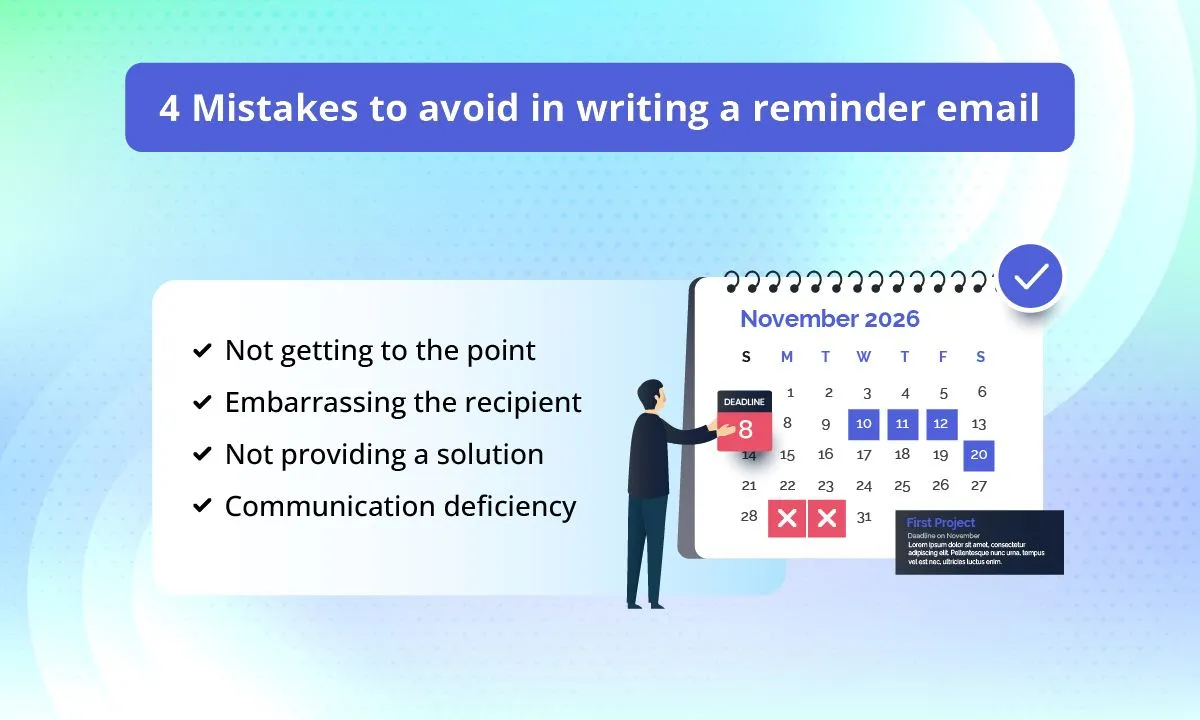
| Common Mistake | What It Means | Better Approach | Example |
|---|---|---|---|
| Being Too Aggressive | Using language that sounds accusatory or demanding can make recipients defensive and harm professional relationships. | Keep the tone polite and neutral. Assume the recipient simply forgot rather than intentionally ignored the request. | Instead of: “You have failed to respond.” → Use: “I’m following up regarding…” |
| Being Too Vague | A reminder email that lacks key information such as dates, payment amounts, or action steps can confuse the recipient. | Always restate important details so the reader immediately understands what the reminder is about. | Include details like: invoice number, meeting time, deadline date, or event link. |
| Over-Explaining | Writing long emails that repeat the entire conversation history can overwhelm the reader and dilute the message. | Keep the reminder short and focused on the immediate action required. | A reminder should summarize the situation briefly rather than restating every prior email. |
| Ignoring Automation | Manually sending reminders increases the chances of delays, missed follow-ups, and inconsistent timing. | Use automated email workflows to schedule reminders at the right intervals. | Automated sequences can send reminders before due dates, after deadlines, or before events. |
| Forgetting the Call to Action | If the recipient is not clearly told what to do next, they may ignore the email or postpone action. | End every reminder email with a clear, direct next step. | Examples: Pay here, Confirm attendance, Reply with feedback, Join the webinar. Without a CTA, reminders rarely convert. |
How to Send a Friendly Reminder Email Without Sounding Pushy
This is one of the most searched questions: how to send a friendly reminder email without damaging relationships.
Follow this structure:
- Assume positive intent
- Be concise
- Restate key details
- Offer help
- Include a clear CTA
Example:
“Just a quick reminder regarding the signed agreement. Please let me know if you need any clarification.”
The language remains neutral. The expectation remains clear.
Uplevel Your Emailing With Mailmunch
Writing effective reminder emails is one part of the process. Sending them consistently, at the right time, and with proper tracking is another.
Platforms like Mailmunch help businesses automate reminder email workflows so nothing slips through the cracks.
With automation, you can:
- Trigger a payment reminder email sequence when an invoice becomes overdue
- Schedule appointment reminder emails 24 hours before meetings
- Send webinar reminder emails at optimized intervals
- Segment audiences based on engagement
- Track open rates, click-through rates, and conversions
Automation ensures that your reminder email template becomes part of a system, not a manual task.
You can also:
- Personalize subject lines
- Insert dynamic fields like names and invoice numbers
- A/B test reminder email examples
- Monitor which reminders convert best
Instead of wondering whether to send a follow-up, the system does it for you.
That’s the difference between reactive emailing and strategic communication.
Final Thoughts
A reminder email is more than a nudge. It is a structured, professional communication tool that protects revenue, increases attendance, drives engagement, and maintains accountability.
Whether you are drafting a:
- Payment reminder email sample
- Professional meeting reminder email template
- Appointment reminder email template
- Invoice reminder email
- Survey reminder email
- Event reminder email
- Gentle reminder email for no response
The fundamentals remain the same:
Clarity. Timing. Tone. Precision.