Customer Retention Email Strategy: Tips, Tricks, and More

Ayesha Ejaz Last updated on
Customer acquisition costs continue to rise across paid media channels, while customer attention spans shrink. For marketing managers responsible for revenue growth, this creates a structural challenge: growth cannot rely solely on new customer acquisition.
This is where a structured customer retention email strategy becomes a revenue engine rather than a support function.
Retention email marketing drives:
- Higher customer lifetime value (CLV)
- Increased repeat purchase rate
- Improved subscription renewals
- Reduced churn
- Stronger brand affinity
- More predictable revenue forecasting
In this comprehensive guide, we will break down what a customer retention email is, why it is underutilized, which retention campaigns are essential, and how leading brands execute high-performing customer retention email campaigns.
What is a Retention Email?
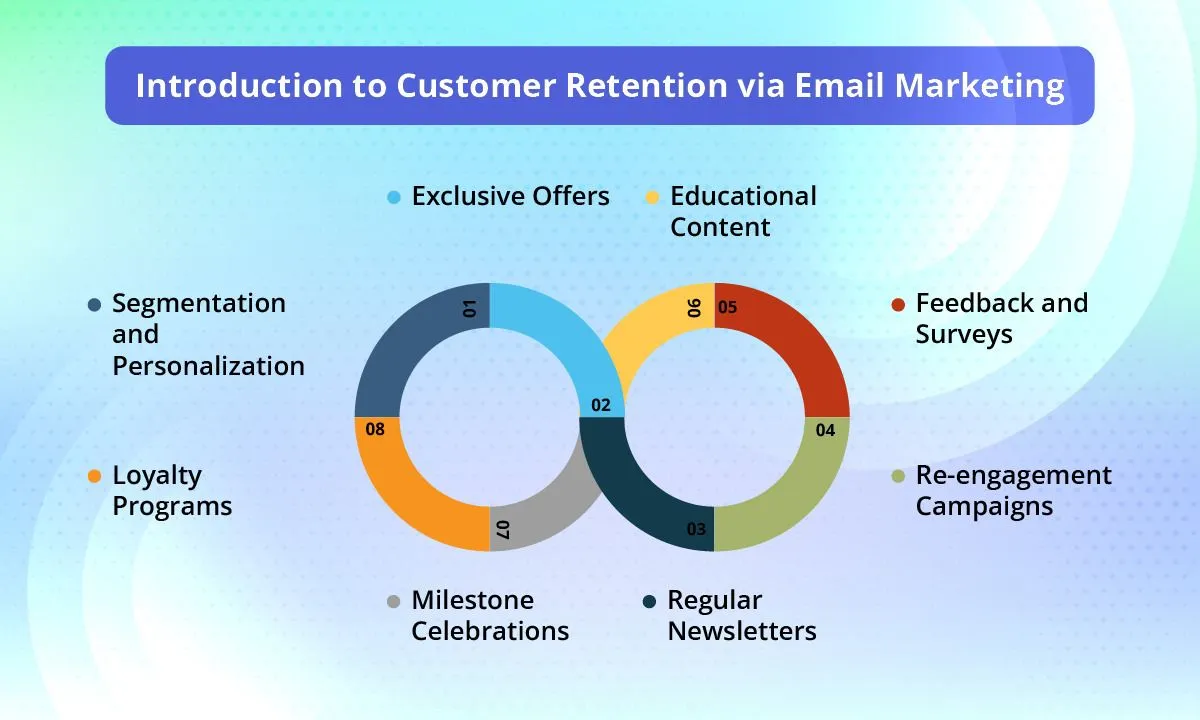
A customer retention email is a lifecycle-driven email designed to maintain, deepen, or reactivate engagement after a customer’s initial conversion.
Unlike acquisition emails, which focus on prospect conversion, retention emails aim to:
- Encourage repeat purchases
- Increase product adoption
- Reinforce value perception
- Prevent churn
- Promote loyalty and advocacy
Retention emails are typically automated, behavior-triggered, and personalized based on customer data.
In advanced retention frameworks, emails are aligned with:
- Customer lifecycle stages
- Behavioral triggers
- Predictive churn signals
- Revenue potential segments
Why Are Retention Emails Underrated?
Despite their ROI potential, retention emails are often deprioritized.
Common reasons include:
- Acquisition bias — Paid growth is easier to measure in dashboards.
- Lack of lifecycle mapping — Teams don’t have structured post-purchase flows.
- Limited segmentation — Generic campaigns reduce effectiveness.
- Underutilized automation tools — Platforms are used for broadcasts rather than behavioral triggers.
However, research consistently shows that increasing retention by even 5% can significantly improve profitability due to reduced CAC amortization and increased LTV.
For SaaS companies, retention directly influences:
- Monthly recurring revenue (MRR)
- Net revenue retention (NRR)
- Expansion revenue
- Churn rate
Retention email marketing is not a tactical add-on; it is a strategic revenue lever.
The Essential Customer Retention Emails You Must Set Up
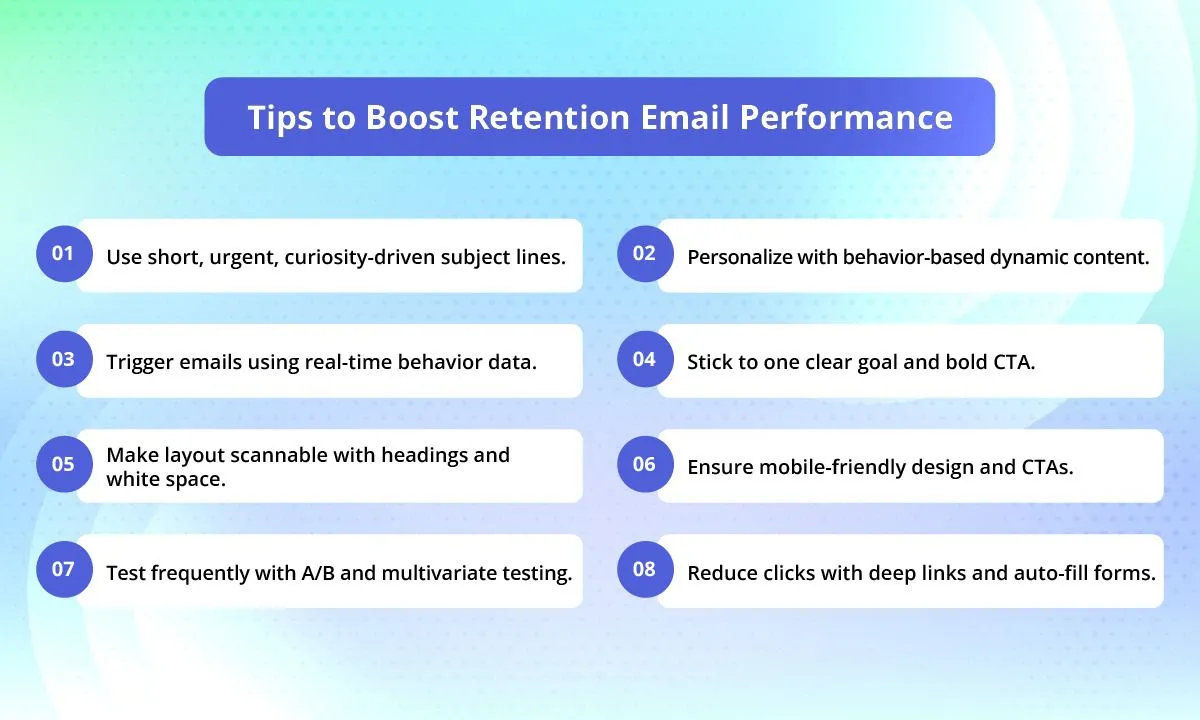
Marketing managers should implement a structured lifecycle system rather than isolated campaigns. Below are essential customer retention email campaigns across industries.
1. Welcome & Onboarding Series
Objective: Establish value quickly and reduce early churn.
This series sets expectations and guides customers toward activation milestones.
Best practices:
- Deliver within minutes of signup or purchase.
- Break onboarding into 3–5 educational steps.
- Highlight key features progressively.
- Include a clear “next step” CTA in each email.
For SaaS customer retention email campaigns, onboarding completion rates strongly correlate with long-term retention.
2. Post-Purchase Reinforcement Emails
Objective: Reduce buyer’s remorse and encourage repeat purchases.
This email typically includes:
- Order confirmation
- Usage instructions
- Product education
- Cross-sell recommendations
- Review requests
Ecommerce brands often see measurable uplift in repeat purchase rate when post-purchase emails include personalized product recommendations.
3. Educational or Value-Driven Content Emails
Objective: Reinforce product value over time.
These emails:
- Share tutorials
- Highlight advanced features
- Provide industry insights
- Showcase case studies
Value-driven retention emails reduce dependency on discount-based re-engagement.
4. Loyalty & Rewards Campaigns
Objective: Incentivize repeat behavior.
Effective loyalty emails include:
- Point balance reminders
- Tier upgrades
- Exclusive member offers
- Birthday or anniversary rewards
Psychological principle leveraged: commitment and reward reinforcement.
5. Re-Engagement Campaigns
Objective: Reactivate dormant customers.
Trigger thresholds vary by industry:
- Ecommerce: 60–90 days inactivity
- SaaS: 14–30 days login inactivity
- Subscription: Missed payment or renewal risk
Effective re-engagement emails:
- Acknowledge inactivity
- Re-emphasize value
- Offer incentive (if necessary)
- Provide a frictionless return path
These are among the most searched customer retention email examples because of their high ROI when executed properly.
6. Renewal & Subscription Reminder Emails
Objective: Reduce involuntary churn.
Best practices:
- Send 7–14 days before renewal.
- Highlight benefits and usage stats.
- Offer upgrade options.
- Provide easy payment update links.
For subscription brands, this is a critical pillar of customer retention email marketing.
7. Feedback & Churn-Prevention Emails
Objective: Understand and prevent churn.
When customers show churn signals:
- Reduced usage
- Cancellation attempt
- Downgrade request
Send:
- Feedback surveys
- Assistance offers
- Personalized outreach
Proactive intervention can significantly reduce churn rates.
Elements of a High-Converting Customer Retention Email
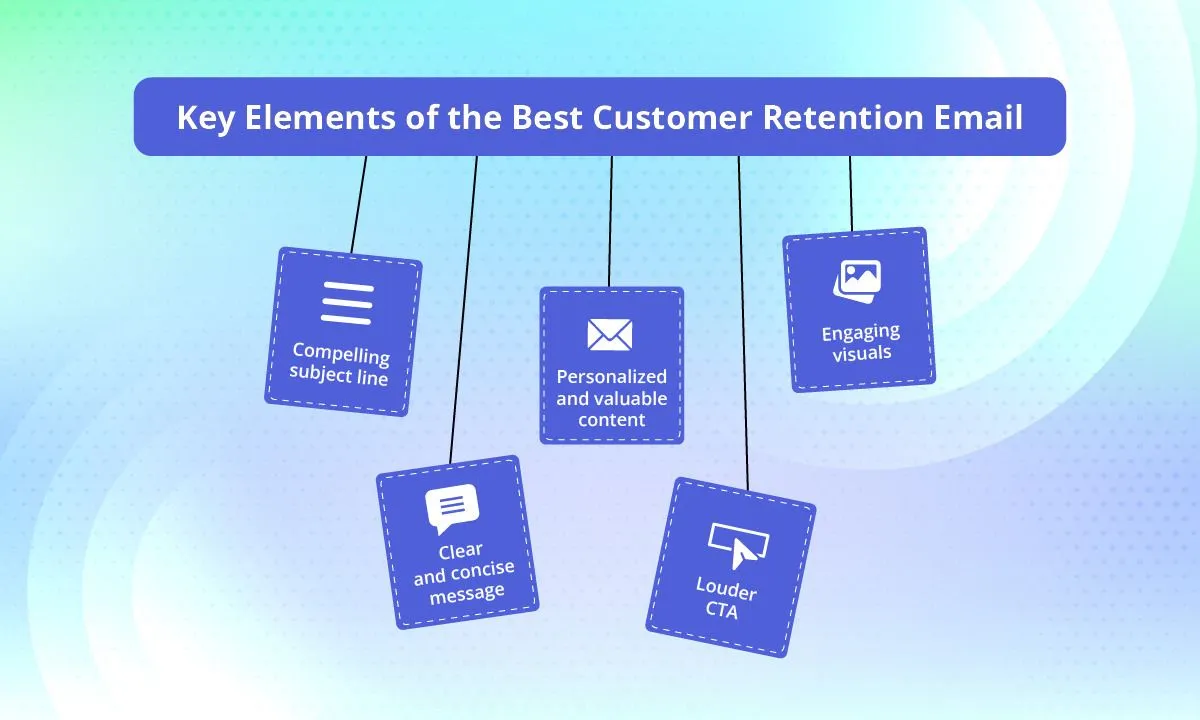
A well-designed customer retention email template should combine psychological triggers with technical optimization.
1. Subject Line Optimization
Your subject line influences open rate, which directly impacts campaign performance.
Effective subject lines:
- Use personalization tokens
- Focus on benefits
- Create mild urgency
- Avoid excessive promotional language
Examples:
- “You’re Close to Your Next Reward”
- “We Added Something New for You”
- “Before Your Subscription Renews…”
A/B testing subject lines should be continuous.
2. Clear, Singular Call to Action (CTA)
Each retention email should focus on one primary objective.
Common CTAs:
- “Resume Your Subscription”
- “Shop Your Favorites”
- “Explore New Features”
- “Complete Your Setup”
Multiple CTAs dilute conversion rates.
3. Engaging Visual Hierarchy
Retention emails should:
- Be mobile-optimized
- Use scannable layouts
- Maintain brand consistency
- Emphasize CTA visually
Design clarity reduces cognitive load.
4. Valuable, Contextual Content
Discount-heavy retention strategies train customers to wait for promotions.
Instead, prioritize:
- Education
- Social proof
- Product updates
- Personalized recommendations
Long-term loyalty comes from perceived value, not constant incentives.
5. Personalization & Segmentation
Advanced segmentation transforms generic campaigns into high-performing ones.
Segment by:
- Purchase frequency
- Product category interest
- Average order value
- Engagement recency
- Lifecycle stage
- Subscription tier
Dynamic content blocks increase relevancy inside a single campaign.
6. Social Proof & Trust Signals
Retention emails benefit from:
- Testimonials
- User milestones
- Case studies
- Community size
- Ratings and reviews
Trust reinforcement reduces churn risk.
7. Accessible Support & Contact Information
Customers should easily access:
- Help centers
- Support chat
- Account management
- FAQs
Accessibility increases perceived reliability.
Boosting Customer Retention: Advanced Tips and Strategies
Retention optimization requires continuous refinement.
Segment for Success
Segmentation is the foundation of scalable customer retention email strategies.
High-value segments may receive:
- Early product access
- Exclusive perks
- Upsell campaigns
Low-engagement segments may receive:
- Educational series
- Incentivized reactivation
Granular segmentation increases engagement metrics significantly.
Create a Positive Customer Experience Beyond Email
Email cannot compensate for poor customer experience.
Focus on:
- Fast delivery
- Transparent pricing
- Responsive support
- Seamless UX
Retention is cross-functional, not just marketing-driven.
Optimize Timing and Frequency
Over-emailing causes fatigue; under-emailing causes forgetfulness.
Best practices:
- Map email frequency to lifecycle stage.
- Suppress inactive users from excessive sends.
- Use behavioral triggers instead of fixed schedules.
Use Data to Predict Churn
Advanced retention teams:
- Monitor login frequency
- Track feature usage
- Analyze repeat purchase intervals
- Score churn probability
Predictive segmentation enhances proactive outreach.
Sample Professional Customer Retention Email Template
Subject: Let’s Pick Up Where You Left Off
Hi [First Name],
We noticed you haven’t logged in recently. Since your last visit, we’ve introduced new features designed to help you achieve [specific benefit].
Here’s what’s new:
- [Feature or update]
- [Improvement or enhancement]
- [Limited-time benefit, if applicable]
Click below to continue where you left off.
[Primary CTA Button]
If you need assistance, our support team is ready to help.
Best regards,
[Company Name]
Measuring Success: Key KPIs for Retention Email Marketing
Retention email marketing should be evaluated through a revenue lens not vanity engagement metrics alone. While opens and clicks provide directional insights, marketing managers must connect retention emails to long-term customer value and revenue stability.
Below is a detailed breakdown of the most important KPIs and how they should be interpreted.
1. Repeat Purchase Rate
Definition:
The percentage of customers who make more than one purchase within a defined time period.
Formula:
(Number of customers with 2+ purchases ÷ Total customers) × 100
Why it matters:
For ecommerce and DTC brands, repeat purchase rate is a primary indicator of retention success. A strong post-purchase and loyalty email sequence should directly increase this metric.
What to monitor:
- Change in repeat rate after implementing automation flows
- Repeat rate by segment (VIP vs. first-time buyers)
- Time between first and second purchase
If your customer retention email campaigns are effective, repeat purchase rate should trend upward over time.
2. Churn Rate
Definition:
The percentage of customers who stop purchasing, cancel subscriptions, or disengage during a specific period.
Formula (SaaS):
(Customers lost during period ÷ Customers at start of period) × 100
Why it matters:
Retention emails aim to reduce churn by reinforcing value and preventing cancellations.
For subscription businesses, even small churn reductions significantly impact revenue predictability.
What to analyze:
- Churn by acquisition channel
- Churn by customer cohort
- Churn after re-engagement campaigns
- Voluntary vs. involuntary churn
A strong customer retention email strategy should reduce churn especially in at-risk segments.
3. Net Revenue Retention (NRR)
Definition:
The percentage of recurring revenue retained from existing customers, including expansions, upgrades, and cross-sells.
Formula:
((Starting Revenue – Churned Revenue + Expansion Revenue) ÷ Starting Revenue) × 100
Why it matters:
NRR is a gold-standard SaaS metric. An NRR above 100% means expansion revenue offsets churn.
Retention emails influence NRR by:
- Promoting feature upgrades
- Encouraging plan expansions
- Preventing downgrades
For SaaS customer retention email campaigns, this KPI connects email strategy directly to board-level metrics.
4. Customer Lifetime Value (CLV)
Definition:
The total revenue expected from a customer throughout their relationship with your business.
Why it matters:
CLV reflects the cumulative effect of retention efforts.
When retention emails:
- Increase purchase frequency
- Extend subscription duration
- Encourage upsells
CLV rises.
Strategic implication:
If CLV increases, you can afford higher acquisition costs without hurting profitability.
Retention email marketing should aim to systematically increase CLV over time.
5. Open Rate
Definition:
The percentage of recipients who open your email.
Why it matters:
Open rate measures subject line effectiveness and brand familiarity.
However:
- Privacy changes have reduced open rate reliability.
- Opens do not equal revenue.
Use open rate as a directional indicator, not a success metric.
6. Click-Through Rate (CTR)
Definition:
The percentage of recipients who click on at least one link within the email.
Why it matters:
CTR indicates message relevance and CTA clarity.
Low CTR may signal:
- Weak personalization
- Unclear messaging
- Poor segmentation
High CTR suggests your customer retention email template aligns with audience intent.
7. Conversion Rate
Definition:
The percentage of recipients who complete the desired action (purchase, renewal, upgrade).
Why it matters:
This is where engagement turns into revenue.
Monitor:
- Conversion rate by lifecycle stage
- Conversion rate by segment
- Conversion rate by incentive type
Retention emails should be optimized toward conversion — not just engagement.
8. Revenue per Email (RPE)
Definition:
Total revenue generated ÷ Number of emails sent.
Why it matters:
RPE connects email campaigns directly to financial performance.
It allows marketing managers to:
- Compare flows vs. broadcasts
- Evaluate re-engagement ROI
- Justify automation investments
This is one of the most practical metrics for demonstrating the financial impact of customer retention email campaigns.
9. Reactivation Rate
Definition:
The percentage of inactive customers who re-engage after a reactivation campaign.
Why it matters:
Dormant customers represent previously acquired CAC. Reactivating them is often more cost-effective than acquiring new ones.
Monitor:
- Reactivation by inactivity duration
- Revenue from reactivated customers
- Long-term retention of reactivated segments
Effective customer retention email strategies should include structured win-back campaigns with measurable reactivation benchmarks.
Connecting Metrics to Business Impact
Retention is not measured by opens alone — revenue impact matters most.
To evaluate success properly:
- Tie engagement metrics to revenue metrics.
High CTR with low conversion signals friction post-click. - Analyze cohort performance.
Measure retention improvements across acquisition cohorts. - Measure incremental lift.
Compare customers exposed to retention campaigns vs. control groups. - Prioritize long-term value over short-term discounts.
Discount-heavy campaigns may boost short-term revenue but harm margins.
A Practical KPI Framework for Marketing Managers
For operational clarity:
Tier 1 (Executive-Level Metrics):
- Net Revenue Retention (NRR)
- Customer Lifetime Value (CLV)
- Churn Rate
- Revenue per Email
Tier 2 (Performance Metrics):
- Conversion Rate
- Reactivation Rate
- Repeat Purchase Rate
Tier 3 (Diagnostic Metrics):
- Open Rate
- Click-Through Rate
This tiered structure ensures retention email marketing is evaluated strategically rather than tactically.
Wrapping Up
A comprehensive customer retention email strategy is one of the most efficient ways to increase profitability without increasing acquisition spend.
To summarize:
- Retention drives sustainable revenue.
- Lifecycle automation ensures scalability.
- Segmentation enhances relevance.
- Personalization improves engagement.
- Value-driven content builds long-term loyalty.
For marketing managers across ecommerce, SaaS, and subscription-based businesses, retention email marketing is no longer optional it is a competitive advantage.
The companies that win are not those that acquire the most customers, but those that retain them the longest.