Inbox Placement: What It Is and Why It Matters

Ayesha Ejaz Last updated on

Email marketing remains one of the most powerful channels for business growth. Whether you are nurturing leads, onboarding users, or converting customers, the key is not just sending emails but ensuring they reach the right place.
Inbox placement is critical because it determines whether a recipient sees your message in the primary inbox rather than the promotions tab, spam folder, or filtered out entirely.
In simple terms, inbox placement refers to the percentage of your emails that successfully land in the primary inbox rather than getting lost or hidden.
In this guide we will define what inbox placement is, why it matters, how it works, common pitfalls, how to improve it, how to measure it, the tools you can use, and what best practices will matter most.
What Is Inbox Placement?
Inbox placement refers to the outcome after an email has been delivered to a recipient’s mail server and accepted. The question becomes: where does it land? Does it arrive in the primary inbox, the promotions or “other” folder, the spam/junk folder, or is it filtered out altogether?
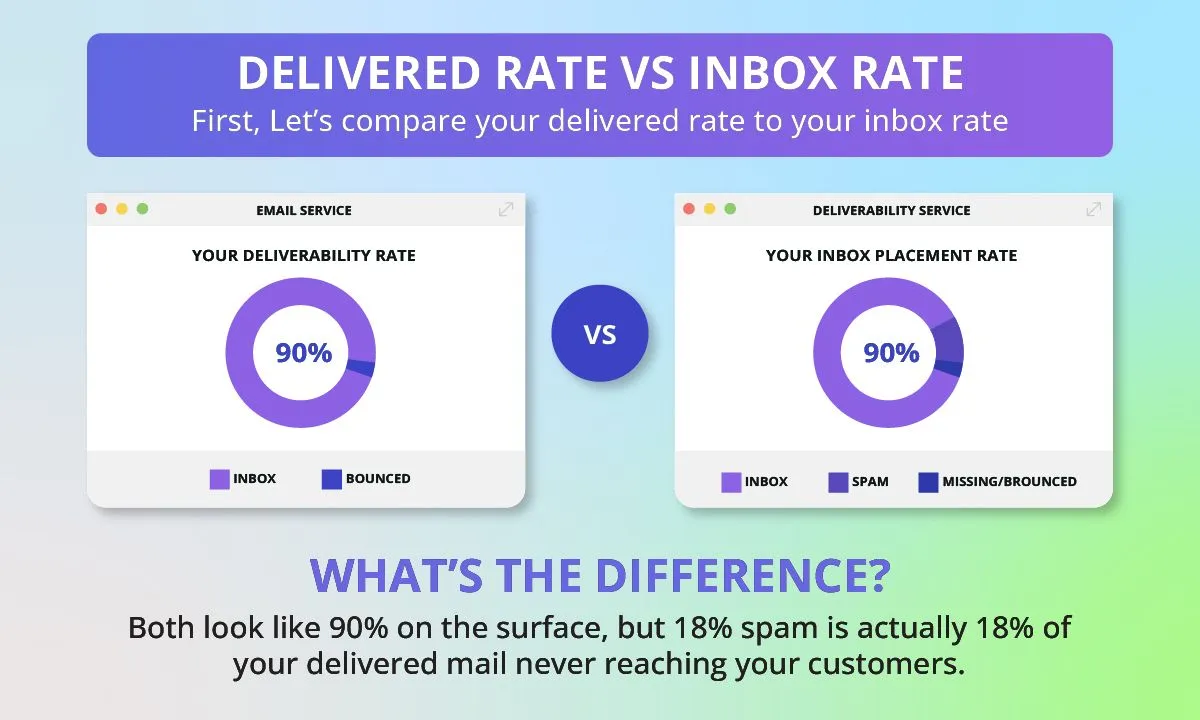
Inbox Placement vs Email Deliverability
It is important to distinguish between two often‐confused concepts:
- Email deliverability is the measure of whether your email was accepted by the recipient’s mail server, meaning it did not bounce or get blocked.
- Inbox placement, on the other hand, is where that delivered email ends up: the primary inbox, the promotions/other tab, or the spam folder.
Therefore you may have high deliverability but poor inbox placement. For example: imagine you send 10,000 emails and 9,800 get delivered (deliverability of 98 %). But if only 5,000 land in the primary inbox, your inbox placement is 5,000/9,800 ≈ 51 %. That dramatically reduces the number of recipients who see your email.
How Inbox Placement Impacts Email Performance
Landing in the inbox instead of spam or promotions matters because it influences:
- Open rates – if your email is hidden, it is far less likely to be opened.
- Click-through rates (CTR) – fewer opens means fewer clicks and fewer conversions.
- Engagement and reputation – mailbox providers (Gmail, Outlook, Yahoo) monitor how people engage with your emails (opens, deletes without reading, spam complaints). Good engagement builds trust; low engagement can harm placement in future sends.
- Return on investment (ROI) – email marketing still produces strong ROI when messages are seen. According to one resource, if your message never reaches the inbox its impact is wasted.
Recent data suggests that average global inbox placement rates are around 85 %.In one analysis from the first quarter of 2025, senders with 200 k-1,000 k monthly emails achieved about 60.96 % inbox rate, while the very large senders (1,000 k+ monthly) saw only 27.63 % — clearly illustrating how scale and list quality matter.
Thus, inbox placement is the gateway to email marketing success. If you are not reaching the inbox you are missing opportunities.
Why Inbox Placement Matters for B2B and B2C Marketing
Whether you are marketing to business clients (B2B) or consumers (B2C), inbox placement should be a key metric for your strategy.
Influence on Open and Engagement Rates
If your emails land in spam or a hidden promotions folder, fewer people will open them. According to benchmarking data, the average email open rate across industries in 2025 is ~42.35 %.If your inbox placement is low, reaching this open average becomes far more difficult.
In B2B scenarios you may have high value leads and lower volume, but if placement is poor your pipeline suffers. In B2C you may send higher volumes, but if many never hit the primary inbox you lose scale.
Domain Reputation and Trust Signals
Mailbox providers treat every sending domain and IP like a brand: they evaluate how trustworthy that sending identity is. Trust is built over time via:
- Low spam complaints
- Good engagement (opens, clicks, replies)
- Low bounce rates
- Correct authentication setup
When your domain has strong reputation, email providers are more likely to deliver your message to the inbox. When reputation is weak, your emails might be sent to spam or dropped altogether. For B2B emails especially, domain reputation and authentication (SPF, DKIM, DMARC) matter a lot.
Because inbox placement directly affects whether your message is seen, not just sent, marketers should treat it as a critical success metric.
How Inbox Placement Works
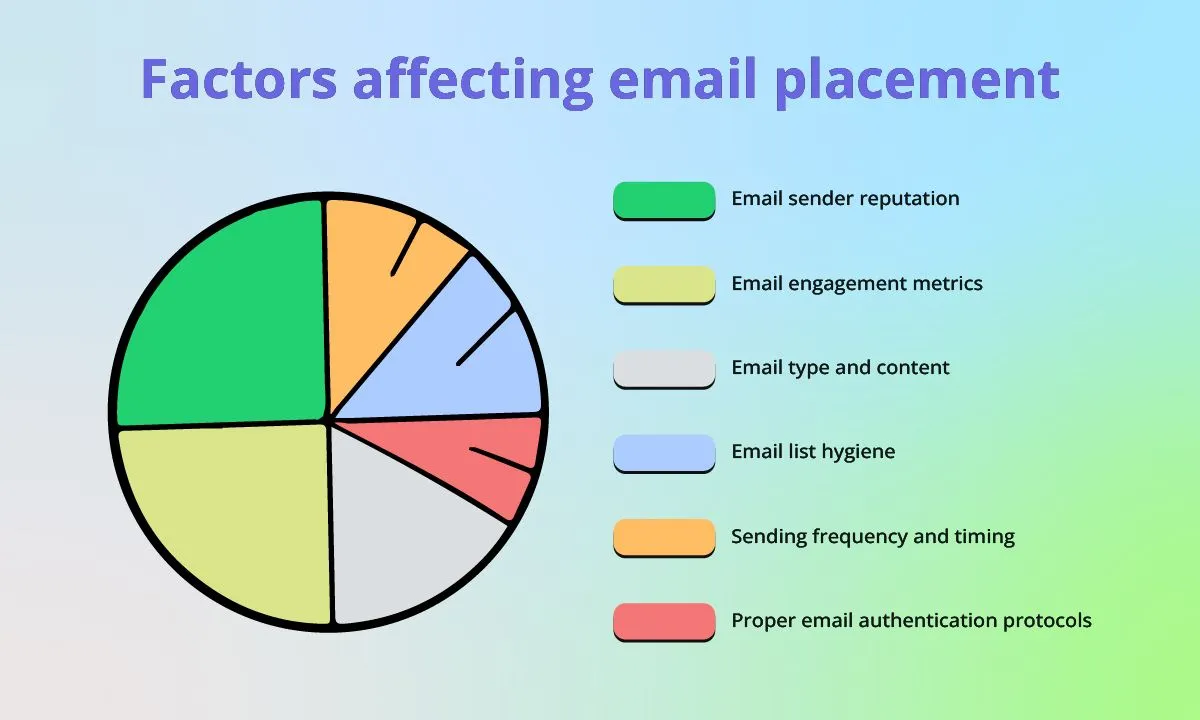
To understand inbox placement, let’s walk through how email delivery and placement works behind the scenes.
Role of Email Service Providers (ESPs)
Your ESP (for example, ActiveCampaign, Mailgun, Mailchimp) is the tool you use to send emails. The ESP will tell you how many emails were sent, how many bounced, how many complaints you had, how many unsubscribes.
The ESP typically cannot tell you whether an email landed in the primary inbox, promotions tab, or spam folder. That determination is made by the recipient’s mailbox provider (for example, Gmail, Outlook, Yahoo) based on their algorithms.
How Spam Filters Score Emails
Mailbox providers use complex algorithms and machine-learning models. They look at many factors including:
- Sender reputation (domain + IP)
- Engagement history (opens, clicks, deletes without reading)
- Bounce rate and complaint rate
- Sending volume and frequency
- Authentication (SPF, DKIM, DMARC)
- Email content, formatting, links, images
- Whether past recipients marked the sender as spam
Based on these signals, the mailbox provider decides whether the email goes to the primary inbox, promotions tab, or spam folder. Poor signals increase the chance of non-inbox placement.
Importance of Sender Reputation
Your sender reputation is like a credit score for email. A strong sender reputation means your emails have a higher chance of landing in the inbox. It is built over time through:
- Sending to lists of engaged recipients
- Avoiding purchased or scraped lists
- Having low bounce and spam-complaint rates
- Using consistent sending patterns (avoiding sudden spikes)
- Implementing full authentication setup
If you ignore reputation and use sloppy practices, your inbox placement will suffer.
Common Reasons Emails Fail to Reach the Inbox
Inbox placement is not guaranteed by simply sending emails. Multiple technical, reputational, and behavioral factors determine whether your message lands in the inbox, spam folder, or is blocked entirely.
Poor Sender Reputation
Sender reputation is one of the most critical factors affecting inbox placement. Internet Service Providers (ISPs) evaluate your sending IP and domain based on historical behavior, including bounce rates, spam complaints, engagement levels, and sending consistency. A poor reputation signals risk and results in filtering or blocking.
Unverified or Low-Quality Email Lists
Sending to outdated, purchased, or scraped email lists significantly harms inbox placement. High bounce rates and low engagement indicate poor list hygiene, which ISPs interpret as irresponsible sending behavior.
Missing Email Authentication (SPF, DKIM, DMARC)
Without proper email authentication, mailbox providers cannot verify that your emails are legitimately sent from your domain. This increases the likelihood of spoofing concerns and drastically reduces inbox placement rates.
Content and Spam Trigger Issues
Overuse of promotional language, misleading subject lines, excessive links, poor HTML structure, or image-heavy emails can trigger spam filters. Even legitimate campaigns can suffer inbox placement issues if content best practices are ignored.
How to Improve Inbox Placement
Improving inbox placement requires a combination of technical setup, list management, and content optimization.
Warm Up Your Domain and IP Address
New domains and IPs should be warmed up gradually by increasing send volume over time and prioritizing engaged subscribers. This builds trust with ISPs and establishes a positive sending reputation.
Validate and Clean Email Lists
Regularly remove invalid, inactive, or unengaged contacts from your lists. Using email validation tools reduces bounce rates and improves overall inbox placement by signaling quality sending behavior.
Optimize Subject Lines and Email Content
Write clear, relevant subject lines that match email content. Avoid spam-trigger words, maintain a balanced text-to-image ratio, and ensure your emails deliver value rather than purely promotional messaging.
Monitor Spam Complaints and Feedback Loops
Feedback loops provided by ISPs alert senders when recipients mark emails as spam. Monitoring and acting on this data helps prevent recurring issues that negatively impact inbox placement.
Email Authentication to Improve Inbox Placement
Email authentication is foundational for achieving consistent inbox placement.
SPF
Sender Policy Framework (SPF) specifies which mail servers are authorized to send emails on behalf of your domain. Proper SPF configuration prevents unauthorized sending and improves trust with ISPs.
DKIM
DomainKeys Identified Mail (DKIM) adds a cryptographic signature to emails, allowing mailbox providers to verify message integrity and sender authenticity.
DMARC
Domain-based Message Authentication, Reporting, and Conformance (DMARC) aligns SPF and DKIM while instructing ISPs on how to handle unauthenticated emails. DMARC also provides reporting to monitor abuse and authentication success.
BIMI (Optional but Recommended)
Brand Indicators for Message Identification (BIMI) allows verified brands to display logos in inboxes. While optional, BIMI enhances brand trust, visibility, and engagement indirectly supporting inbox placement.
How to Calculate Inbox Placement Rate
Understanding your inbox placement rate helps measure deliverability performance beyond basic delivery metrics.
Inbox Placement Rate Formula
Inbox Placement Rate (%) = (Emails Delivered to Inbox ÷ Emails Sent) × 100
Example Calculation
If you send 10,000 emails and 8,200 land in the inbox (excluding spam and blocks), your inbox placement rate is:
(8,200 ÷ 10,000) × 100 = 82%
Inbox Placement Testing
Inbox placement testing allows marketers to proactively identify deliverability issues.
| Aspect | Description |
|---|---|
| Purpose of Inbox Placement Testing | Inbox placement testing helps marketers proactively identify email deliverability issues by analyzing where emails land across different mailbox providers. |
| What Is an Inbox Placement Test? | An inbox placement test simulates sending emails to seed accounts across multiple ISPs to determine whether messages arrive in the inbox, spam folder, or promotions tab. |
| Free Inbox Placement Tests | Free tools offer basic insights with limited mailbox provider coverage and minimal diagnostic reporting, suitable for small-scale or initial testing. |
| Paid Inbox Placement Tests | Paid tools provide broader ISP coverage, historical trend analysis, spam filter diagnostics, authentication validation, and actionable recommendations to improve inbox placement. |
| How Inbox Placement Testing Works | Emails are sent to monitored test addresses. The tool tracks inbox, spam, or tab placement and highlights potential issues related to sender reputation, authentication, and content. |
Best Practices for High Inbox Placement in 2026
Inbox placement standards continue to evolve as mailbox providers increasingly prioritize user experience, engagement quality, and sender trust. In 2026, ISPs such as Gmail, Outlook, and Yahoo rely heavily on behavioral signals and consistency rather than just technical compliance.
Marketers must align strategy, automation, and content with these expectations to maintain high inbox placement.
Maintain High Engagement Metrics
Engagement is now one of the strongest predictors of inbox placement. Mailbox providers analyze how recipients interact with your emails over time to determine whether future messages deserve inbox visibility.
Key engagement signals include:
- Open rates and read duration
- Click-through rates
- Replies and forwards
- Adding the sender to contacts or address books
- Low delete-without-reading behavior
To sustain strong engagement, prioritize sending to subscribers who have interacted within the last 30–90 days. Gradually suppress or sunset inactive contacts rather than repeatedly attempting to re-engage them. Additionally, encourage positive actions such as replying to emails or whitelisting your domain to reinforce trust signals that improve inbox placement.
Avoid Spam-Like Automation Patterns
While automation remains essential for scalability, overly aggressive or repetitive automation can negatively impact inbox placement. ISPs can detect unnatural sending behavior that resembles spam rather than genuine communication.
Common automation practices that harm inbox placement include:
- Sending identical content to large segments simultaneously
- Excessive daily or weekly send frequency
- Triggering long email sequences without engagement-based exits
- Using generic templates with minimal variation
To mitigate these risks, vary subject lines, email copy, and send times within automated flows. Implement engagement-based logic that pauses or ends sequences when recipients stop interacting. Gradual pacing and human-like sending patterns signal legitimacy and protect long-term inbox placement.
Personalization and Relevance Strategy
In 2026, personalization goes far beyond first-name tokens. Mailbox providers reward relevance because it directly impacts user engagement and satisfaction.
Effective personalization strategies include:
- Behavioral segmentation based on browsing, purchase, or email activity
- Lifecycle-based messaging aligned with onboarding, retention, or reactivation stages
- Dynamic content blocks tailored to interests or past interactions
- Contextual timing based on user behavior rather than fixed schedules
Highly relevant emails generate stronger engagement signals, reduce spam complaints, and increase inbox placement consistency. When subscribers regularly interact with your emails because they find them useful, mailbox providers are far more likely to prioritize your messages in the inbox.
Key Takeaways
Inbox placement is a critical metric that goes beyond simple email delivery. Achieving high inbox placement requires strong sender reputation, clean email lists, proper authentication, relevant content, and continuous testing. By following best practices and leveraging the right tools, marketers can significantly improve visibility, engagement, and ROI from email campaigns.