How to Find Content Ideas for Email Marketing: A Complete Guide
Last updated on
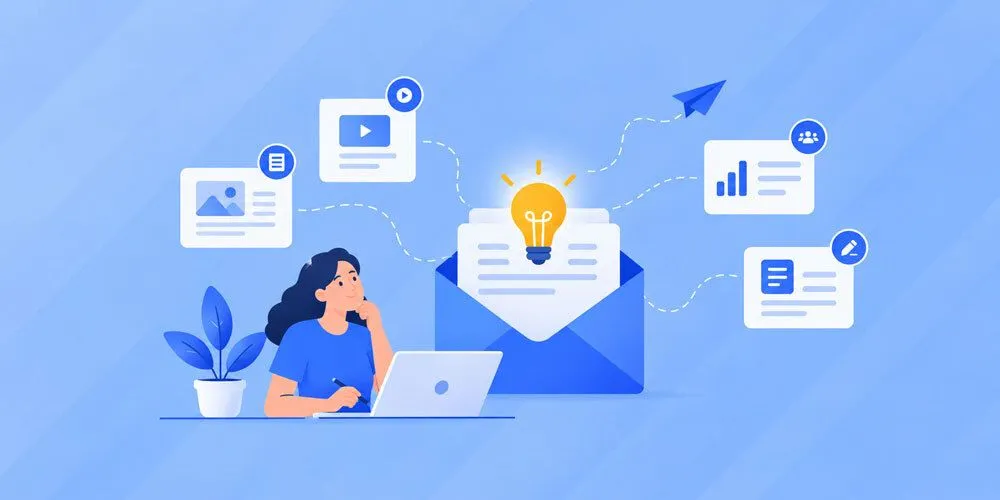
Coming up with fresh email content can be one of the hardest parts of email marketing.
You may know that you should email your subscribers regularly, but after sending newsletters, promotions, product updates, and company announcements, you can quickly run out of things to say.
This is where having a reliable process to find content ideas for email marketing becomes important.
Instead of waiting for inspiration every time you need to send an email, you can use your audience, existing content, customer questions, industry trends, and your own business activities as sources of ideas.
Whether you're completely new to email marketing or already managing an established subscriber list, there are plenty of ways to keep your email calendar full.
In this guide, we'll explain how to find content ideas for email marketing, where to look for inspiration, which types of emails you can create, and how to turn a single idea into multiple campaigns.
Why Is It Difficult to Find Email Marketing Content Ideas?
Email marketing requires consistency.
Your subscribers may expect a weekly newsletter, monthly update, promotional campaign, or regular educational content. The more frequently you send emails, the more ideas you need.
The problem is that marketers often approach email content from only one direction:
"What can we tell our subscribers this week?"
That question can quickly become difficult to answer.
A better approach is to ask:
- What problems does my audience have?
- What questions do customers keep asking?
- What content have people already responded to?
- What is happening in my industry?
- What products or services can I explain better?
- What existing content can I repurpose?
- What can I teach my subscribers?
- What can I share that is useful, entertaining, or relevant?
Once you start looking at email content this way, ideas become much easier to find.
15 Ways to Find Content Ideas for Email Marketing
There is no single source of email content ideas. The best marketers usually collect ideas from several places.
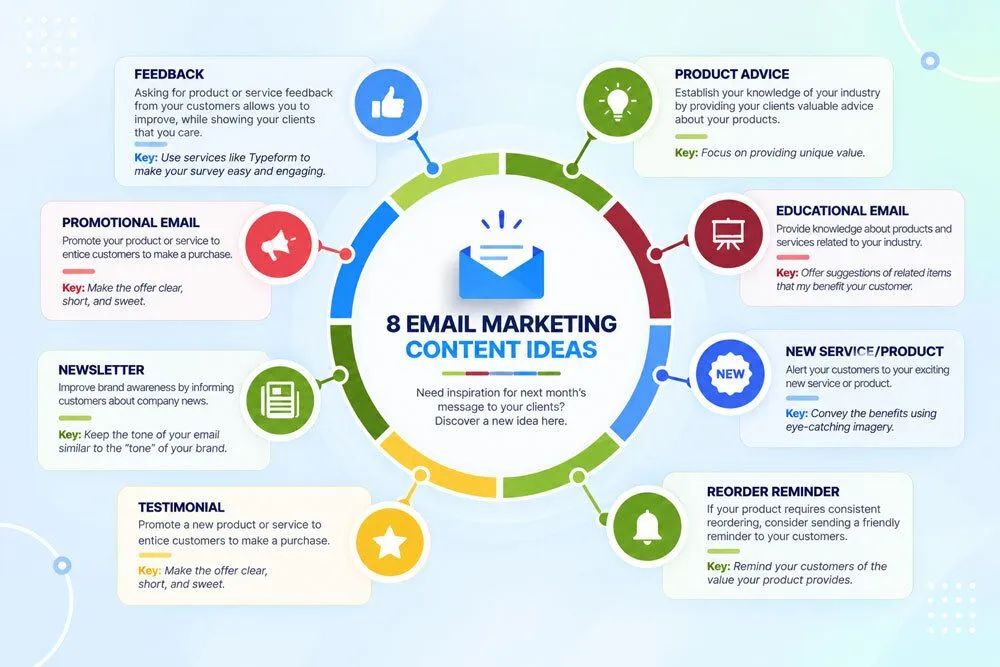
Here are 15 practical ways to find content ideas for email marketing.
1. Look at Your Most Popular Blog Posts
Your existing blog content is one of the easiest places to find email ideas.
If you already have articles that generate traffic, engagement, or conversions, you don't need to start from scratch.
Turn your best-performing blog posts into email content.
For example, if you have a blog post called:
"10 Email Marketing Mistakes to Avoid"
You could create an email around:
"Are You Making These 3 Email Marketing Mistakes?"
Instead of sending the entire article, summarize the key points and encourage subscribers to read the full post.
You can also turn individual sections of a long article into separate emails.
One 2,500-word article could potentially provide several weeks of newsletter content.
2. Use Customer Questions
Your customers are constantly telling you what they want to know.
Pay attention to questions received through:
- Customer support
- Sales calls
- Live chat
- Social media
- Contact forms
- Product reviews
- Community discussions
- Direct messages
If several customers ask the same question, that is a strong signal that it could become an email topic.
For example:
Customer question:"How often should I send marketing emails?"
Email idea:"How Often Should You Send Marketing Emails?"
This approach has an important advantage: you're creating content based on an actual audience need rather than guessing what people might find useful.
3. Check Your Search Data
Search behavior can reveal what your audience wants to learn.
Look at the questions and topics people are searching for around your industry.
For example, an email marketing company might find searches related to:
- How to build an email list
- How to improve email open rates
- How to write better subject lines
- What is email automation?
- How to avoid spam filters
- How often should you send emails?
Each topic can become an email.
Search data can also help you discover long-tail questions that may be too specific for a broad blog post but perfect for a short newsletter.
4. Turn FAQs Into Emails
Frequently asked questions are another valuable source of ideas.
Create a list of the questions your audience asks repeatedly.
Then turn each question into an email.
For example:
FAQ:"What is the difference between an automated email and a regular campaign?"
Email:"Automated Emails vs. Campaign Emails: What's the Difference?"
This type of content is particularly useful because it addresses a specific problem.
You don't need to create a complicated email. Answer the question clearly, provide an example, and include a relevant next step.
5. Repurpose Existing Content
You don't always need brand-new ideas.
Instead, look at what you've already created.
You can repurpose:
- Blog posts
- Videos
- Podcasts
- Webinars
- Social media posts
- Case studies
- Reports
- Guides
- Ebooks
- Customer stories
For example, a webinar about email automation could become:
- A newsletter summarizing the webinar
- An email explaining three automation strategies
- An email featuring common automation mistakes
- A case study
- A checklist
One piece of content can therefore become multiple email campaigns.
6. Follow Industry Trends
Industry trends can give your email strategy a steady supply of topics.
If something new is happening in your industry, explain what it means for your subscribers.
But don't simply repeat the news.
Add context.
For example:
Weak email idea:
"AI is becoming more popular."
Stronger email idea:
"5 Ways AI Is Changing Email Marketing"
The second idea gives your audience something useful rather than simply reporting that a trend exists.
7. Monitor Social Media Conversations
Social media can provide a constant stream of content ideas.
Look at:
- Questions people ask
- Comments on industry posts
- Common complaints
- Popular discussions
- Frequently shared content
- Emerging topics
You can also look at the conversations happening around your own brand.
If people repeatedly discuss the same issue, consider creating an email that addresses it.
Social media can tell you what people are talking about, while email allows you to provide a more detailed response.
8. Analyze Your Previous Emails
Your previous email campaigns contain valuable information about what your audience likes.
Look at metrics such as:
- Opens
- Clicks
- Click-through rate
- Conversions
- Unsubscribes
- Replies
If a particular topic generated strong engagement, explore it further.
For example, suppose an email titled:
"5 Ways to Improve Your Email Subject Lines"
performed particularly well.
Instead of moving on immediately, create related content:
- "10 Subject Line Mistakes to Avoid"
- "How to Write Subject Lines That Get Attention"
- "Subject Line Examples for Different Industries"
- "A/B Testing Your Email Subject Lines"
One successful topic can become a content cluster.
9. Ask Your Subscribers What They Want
Sometimes the easiest way to find email ideas is to ask your audience directly.
You can send a simple survey asking:
"What would you like us to cover in our next newsletter?"
Give subscribers several options or allow them to submit their own answers.
You can also use polls, quizzes, or preference centers to understand their interests.
This gives you two benefits:
- You get content ideas.
- You learn more about your audience.
Both can improve your email marketing strategy.
10. Use Seasonal Events
Seasonal events can give your email calendar a natural structure.
Depending on your business, you could create content around:
- New Year
- Valentine's Day
- Ramadan
- Eid
- Back-to-school season
- Black Friday
- Cyber Monday
- Christmas
- End-of-year planning
However, your email doesn't always need to be promotional.
For example, instead of simply offering a Black Friday discount, an email marketing company could send:
"How to Prepare Your Email List for Black Friday"
This provides educational value while remaining relevant to the season.
11. Create How-To Emails
Educational content is one of the easiest ways to consistently generate email ideas.
Think about the things your customers need to accomplish.
Then turn them into step-by-step emails.
Examples include:
- How to build an email list
- How to write a welcome email
- How to create an abandoned cart campaign
- How to segment subscribers
- How to improve email deliverability
- How to create an automated workflow
A how-to email doesn't need to be extremely long.
Give subscribers a clear process they can follow and link to a more detailed resource when appropriate.
12. Turn Mistakes Into Content
Mistakes are useful content because they help readers avoid problems.
Create emails around common mistakes your audience makes.
For example:
"7 Email Marketing Mistakes That Can Hurt Engagement"
Or:
"5 Common Newsletter Mistakes and How to Fix Them"
You can also share lessons from your own experiences.
This can make educational content feel more practical and relatable.
13. Share Case Studies and Customer Stories
Case studies can turn abstract advice into real-world examples.
Instead of simply saying:
"Email automation can save time."
Show how a company used automation to solve a specific problem.
A case-study email can include:
- The original challenge
- The strategy
- What was implemented
- The results
- Key lessons
Even if you don't have a formal case study, you can share a customer story or practical example.
14. Create Curated Content
You don't always have to create everything yourself.
You can curate useful resources for your subscribers.
For example:
"5 Email Marketing Resources Worth Reading This Month"
You could include:
- Industry articles
- Useful tools
- Research
- Reports
- Templates
- Guides
The key is to add context.
Don't simply give your audience a list of links. Explain why each resource is useful.
15. Turn Your Product Features Into Educational Content
If you're promoting a software product, don't limit your emails to feature announcements.
Turn features into educational topics.
For example, instead of:
"Our platform now has A/B testing."
Try:
"How to Use A/B Testing to Improve Your Email Campaigns"
Then explain how the feature can help readers accomplish that goal.
This shifts your email from a product pitch to useful content.
Types of Email Content You Can Create
Finding ideas becomes easier when you know the different types of email content available.
Here are some common email formats.
Educational Emails
Teach subscribers something useful.
Examples:
- Tutorials
- How-to guides
- Tips
- Checklists
- Best practices
- Mistakes to avoid
Promotional Emails
Promote:
- Products
- Services
- Discounts
- Sales
- Limited-time offers
- New launches
Newsletter Emails
A newsletter can combine multiple types of content.
For example:
This month's newsletter
- Industry update
- New blog post
- Marketing tip
- Product update
- Customer story
Curated Emails
Collect useful resources and share them with your audience.
Announcement Emails
Use these to announce:
- New products
- New features
- Company updates
- Events
- Partnerships
Engagement Emails
These are designed to encourage subscribers to interact.
Examples include:
- Surveys
- Polls
- Quizzes
- Questions
- Contests
User-Generated Content Emails
Share customer:
- Reviews
- Testimonials
- Photos
- Stories
- Results
How to Turn One Idea Into Multiple Emails
One of the best ways to avoid running out of content ideas is to expand a single topic.
Let's say your main topic is:
Email List Building
You could create:
- How to Build an Email List
- 10 Email List Building Mistakes
- Lead Magnet Ideas for Growing Your List
- How to Create a Signup Form
- How to Improve Your Signup Conversion Rate
- Email List Building Tools
- How to Keep New Subscribers Engaged
- Email List Segmentation Tips
You've gone from one topic to eight potential emails.
You can repeat this process for almost any broad topic.
Create an Email Content Idea Bank
Don't wait until the day before your newsletter is due to think of an idea.
Create an email content idea bank.
This can be a simple spreadsheet or document containing:
| Idea | Content Type | Audience | Status |
|---|---|---|---|
| Subject line Mistakes | Educational | Beginners | Idea |
| Product Launch Checklist | Case Study | Marketers | Drafting |
| Customer Success Strategies | How To's | Businesses | Planned |
| Email Automation Tips | Educational | SMBs | Idea |
Whenever you find an interesting topic, add it to the bank.
Over time, you'll build a collection of ideas that you can use whenever your content calendar needs something new.
Build an Email Content Calendar
Once you've collected your ideas, organize them into a content calendar.
A simple monthly calendar could look like this:
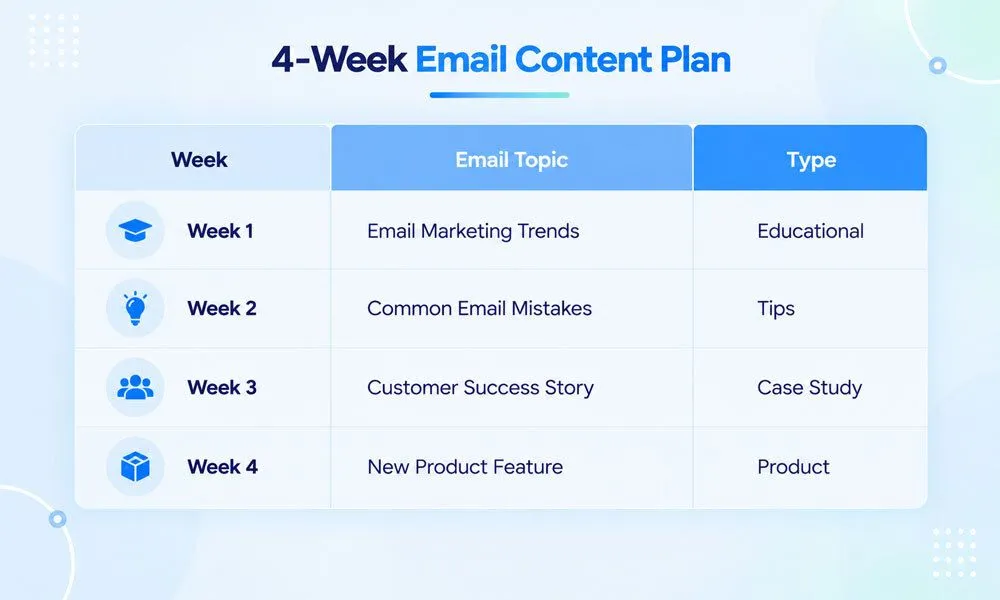
This prevents your email strategy from becoming repetitive.
For example, you may not want to send four promotional emails in a row.
Instead, balance promotional content with educational and engaging content.
How to Know Which Email Ideas Are Worth Using
Not every idea needs to become an email.
Before adding an idea to your content calendar, ask:
Is it useful?
Does the topic solve a problem or answer a question?
Is it relevant?
Does it relate to your audience and your business?
Is it timely?
Is there a reason your audience would care about this topic now?
Is it actionable?
Can readers do something with the information?
Does it support your goals?
Does the email contribute to awareness, engagement, leads, sales, retention, or another business objective?
These questions can help you filter weak ideas before spending time creating them.
Use the Customer Journey to Find Email Ideas
Another useful approach is to create content based on where subscribers are in the customer journey.
New Subscribers
They may need:
- Welcome emails
- Educational resources
- Product introductions
- Beginner guides
Engaged Subscribers
They may be interested in:
- Advanced tips
- Case studies
- Product comparisons
- Webinars
- Detailed guides
Potential Customers
They may need:
- Product demonstrations
- Testimonials
- FAQs
- Case studies
- Feature explanations
Existing Customers
They may benefit from:
- Product tips
- Tutorials
- New features
- Cross-sell opportunities
- Loyalty content
This approach helps ensure that your emails aren't just interesting but relevant to the recipient.
Use Email Segmentation to Generate Better Ideas
Segmentation can also help you create more specific content.
Instead of asking:
"What should we email our audience?"
Ask:
"What does this particular segment need?"
For example, an email marketing platform could have segments for:
- New users
- Trial users
- Paying customers
- Advanced marketers
- Ecommerce businesses
- Agencies
Each group may need different content.
A beginner might want:
"How to Create Your First Email Campaign"
An experienced marketer might prefer:
"Advanced Email Automation Strategies"
The more you understand your audience segments, the easier it becomes to generate relevant content.
How to Find Email Content Ideas Without Copying Competitors
Competitor research can help you identify topics, but the goal should not be to copy another company's email strategy.
Instead, look for gaps.
If several companies are talking about a topic, ask:
- What information are they missing?
- Can we explain it more clearly?
- Can we provide a practical example?
- Can we approach the problem from a different angle?
- What questions are they not answering?
This can help you create original content that provides additional value.
What to Do When You Completely Run Out of Email Ideas
Sometimes you will genuinely feel like you have nothing left to say.
When this happens, go back to your audience.
Look at:
- Customer questions
- Support tickets
- Sales conversations
- Comments
- Reviews
- Previous campaign data
- Search queries
- Popular blog posts
You can also revisit old emails.
Ask yourself:
"Can I update this?"
An old email might become a new one with:
- Updated statistics
- New examples
- New screenshots
- New strategies
- Updated recommendations
You don't always need a completely original topic. Sometimes you need a better or more current version of an existing one.
25 Quick Content Ideas for Email Marketing
If you need inspiration right now, here are 25 email ideas you can adapt to almost any industry:
- A beginner's guide to your industry
- Common mistakes to avoid
- Five tips for getting better results
- A customer success story
- A behind-the-scenes look
- Frequently asked questions
- A step-by-step tutorial
- A useful checklist
- Industry trends
- Expert tips
- Product tips
- New feature announcement
- Product comparison
- Customer testimonials
- A curated resource list
- A monthly roundup
- A seasonal guide
- A case study
- A myth vs. reality email
- A "how it works" email
- A problem-and-solution email
- A common mistake email
- A poll or survey
- A product use case
- A "things we wish we knew" email
Use these as starting points rather than rigid templates.
A Simple Framework for Generating Email Ideas
If you want a repeatable process, use this framework:
Audience + Problem + Solution + Format
For example:
Audience: Small business owners Problem: They struggle to grow their email list Solution: Give them practical list-building strategies Format: Five-step guide
This gives you:
"5 Ways Small Businesses Can Build an Email List"
Another example:
Audience: Ecommerce marketersProblem: Customers abandon their cartsSolution: Explain abandoned cart emailsFormat: Mistakes to avoid
This becomes:
"7 Abandoned Cart Email Mistakes to Avoid"
You can use this formula whenever you need a new idea.
Final Thoughts
Learning how to find content ideas for email marketing is less about constantly coming up with completely original topics and more about knowing where to look.
Your customers, existing content, search data, social media conversations, industry trends, product updates, and previous campaigns can all provide valuable inspiration.
The key is to create a system.
Build an idea bank, maintain a content calendar, study your email performance, listen to your audience, and repurpose content whenever possible.
Most importantly, focus on relevance.
Your subscribers don't need an endless stream of emails. They need emails that give them something useful, interesting, timely, or valuable.
When you build your email strategy around your audience's actual needs, finding content ideas becomes much easier, and your email calendar can keep growing without forcing you to start from a blank page every week.