

Last updated on
September 27, 2026
Choosing email marketing software can seem straightforward until you actually start comparing platforms.
At first, most businesses look for basic features such as email templates, contact management, newsletters, analytics, and scheduling. But as your email marketing becomes more sophisticated, you quickly realize that sending emails is only one part of the equation. You also need to understand your audience, segment contacts, personalize campaigns, automate repetitive tasks, track customer behavior, and turn those interactions into measurable business results.
For agencies, SaaS companies, resellers, franchises, consultants, and businesses that want to offer email marketing under their own brand, there is another consideration: white labeling.
A white label email marketing software with automation combines the functionality of an email marketing platform with the flexibility to present that technology as your own. Instead of simply recommending a third-party tool to clients or users, you can offer an email marketing solution under your own branding while using an established platform behind the scenes.
However, not every white label email platform offers the same capabilities, particularly when it comes to automation.
If you are currently researching email marketing software and are unsure what you actually need, this guide will help you understand the most important features, how email automation fits into the picture, and what to consider before making a purchase.
Our first recommendation is Mailmunch White Label, particularly for companies that want a combination of branded email marketing, automation, lead generation, analytics, integrations, and scalability in one platform. Mailmunch provides white label email marketing and automation capabilities designed for businesses that want to launch the technology under their own brand.
White label email marketing software is an email marketing platform that can be customized and presented under another company's brand.
In a traditional email marketing setup, you purchase a subscription to a platform and use its branding, interface, infrastructure, and customer experience. Your customers or team members know exactly which software they are using.
With white label software, the experience can be branded around your business instead.
For example, an agency could offer email marketing services to its clients through a platform that carries the agency's branding rather than sending clients to a third-party email provider. Similarly, a SaaS company could incorporate email marketing capabilities into its product offering without developing an entire email marketing infrastructure from scratch.
This makes white label email marketing particularly attractive to:
The major advantage is that you do not have to build every component of an email marketing platform yourself.
Instead, you can use an established technology foundation and focus your resources on your brand, customers, positioning, sales, and business growth.
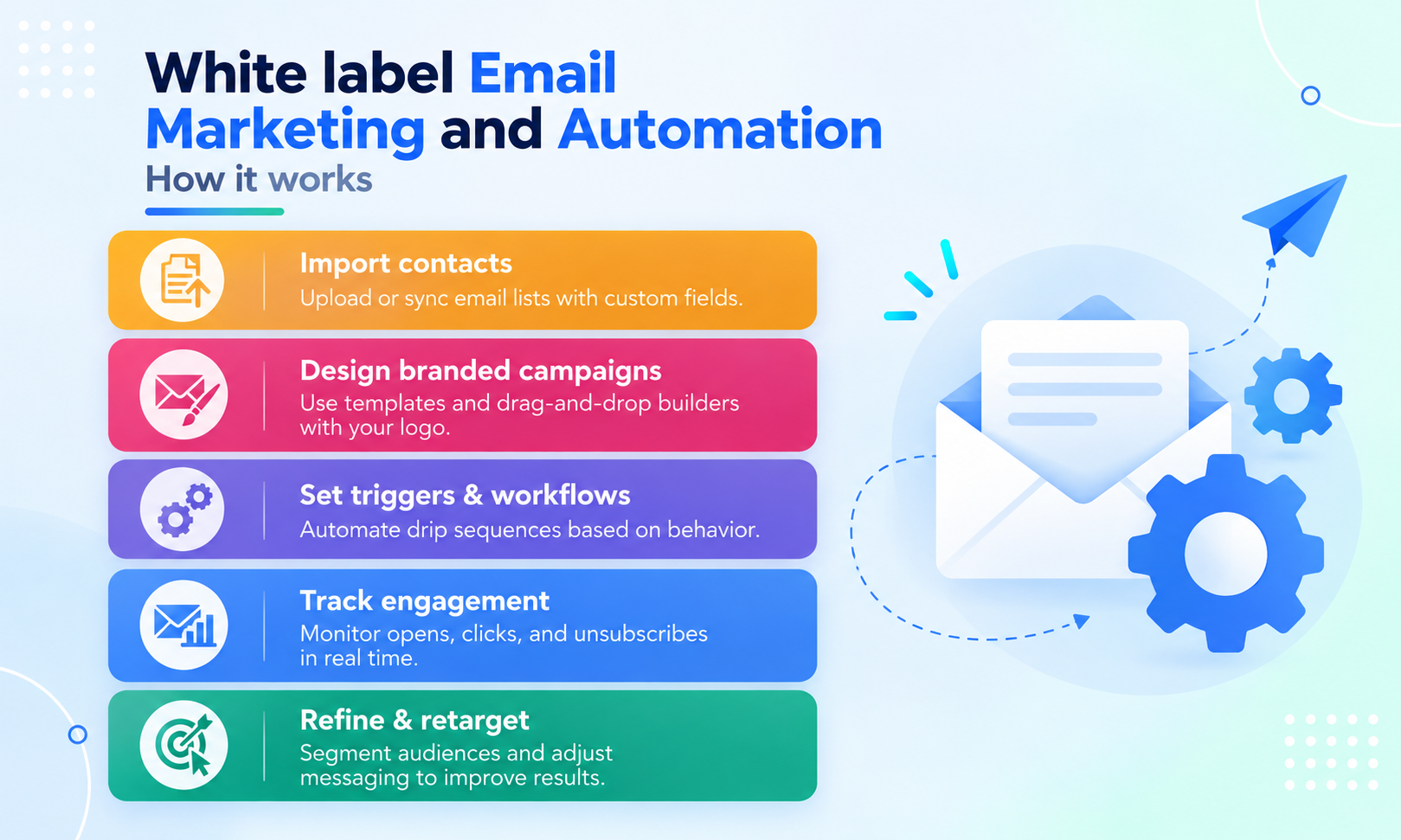
This is where the distinction between basic white label email software and a white label email marketing software with automation becomes important.
Sending a newsletter manually is relatively simple.
But imagine having to manually send an email every time someone:
As your audience grows, manually managing these activities becomes inefficient.
Email automation allows businesses to create predefined workflows that respond to customer actions or specific conditions.
For example:
Visitor submits a form → Welcome email → Wait 2 days → Educational email → Wait 3 days → Product email → If clicked, send offer → If not clicked, send follow-up
Once the workflow is configured, the system can manage the journey automatically.
This means your marketing team can spend less time performing repetitive tasks and more time developing strategy, content, offers, and customer experiences.
Mailmunch's white label automation platform supports behavior-based workflows, visual workflow creation, triggers, conditional logic, lead scoring, wait steps, goal tracking, and CRM and ecommerce integrations.
If you are buying email marketing software for the first time, it can be tempting to compare platforms based only on price.
That is usually not enough.
The cheapest platform may become expensive if it lacks the features you need and forces you to purchase additional tools later.
Instead, evaluate the software based on the following areas.
The first question should be simple:
How much of the platform can actually be branded as your own?
A true white label solution should go beyond placing your logo on an email.
Consider whether you can customize elements such as:
This matters because your customers should have a consistent experience with your brand.
Mailmunch positions its white label platform around complete brand customization, allowing companies to launch the platform under their own identity without having to build the technology themselves.
For agencies, this can make the difference between simply reselling software and creating a branded technology offering.
Automation does not matter if the emails being sent look poor or take too long to create.
Look for a drag-and-drop email builder that allows you to create professional campaigns without requiring HTML or coding expertise.
Important capabilities include:
Mailmunch White Label includes a drag-and-drop email builder and a large template library designed to help users create professional emails without coding.
This is particularly useful if you are offering email marketing to clients who may not have dedicated designers or developers.
A modern automation builder should make customer journeys easy to understand.
Instead of managing complicated rules through confusing menus, a visual workflow builder lets you see the entire journey.
For example:
New Subscriber → Welcome Email → Wait 2 Days → Link Clicked? → Yes: Product Email → No: Educational Email
This makes it easier to build, review, troubleshoot, and improve automated campaigns.
Mailmunch's automation builder uses a visual canvas where users can connect triggers, conditions, actions, waits, splits, and goals to create multi-step workflows.
For businesses purchasing automation software for the first time, visual workflow functionality should be high on the checklist.
Good automation should respond to what subscribers actually do.
Look for software that allows workflows to begin or change based on customer behavior.
Examples include:
This turns email marketing from a simple broadcasting system into a responsive customer communication platform.
For example, rather than sending the same three emails to everyone, you can create different journeys based on whether a subscriber engages with your content.
Mailmunch supports triggers such as form submissions, link clicks, purchases, dates, custom API events, and contact field changes.
Automation becomes much more effective when combined with segmentation.
Segmentation means dividing your audience into groups based on characteristics, behavior, engagement, or other criteria.
You might create segments for:
The more sophisticated your segmentation, the more relevant your automated communication can become.
Mailmunch supports dynamic segmentation based on contact attributes, engagement, behavior, purchases, clicks, opens, forms, and other activity. Its segments can automatically update as contact data changes.
This is important because your audience is not static.
Someone who was a new subscriber yesterday may become a customer today. Your email marketing platform should be able to recognize that change and adjust their communication accordingly.
A platform may claim to offer automation, but you should look at what you can actually automate.
At minimum, consider whether the platform supports common workflows such as:
Welcome automation introduces new subscribers to your company immediately after they join your list.
A simple workflow could include:
Signup → Welcome Email → Brand Introduction → Educational Content → Product Offer
Drip campaigns send a series of emails over a predefined period.
They are useful for:
For ecommerce businesses, abandoned cart automation can help recover potential purchases.
A customer adds a product to their cart but does not complete checkout.
The system can automatically send a reminder and potentially follow it with another message if the customer still does not purchase.
The relationship does not have to end after a transaction.
Post-purchase workflows can include:
Purchase → Thank You → Product Education → Review Request → Cross-Sell → Loyalty Offer
Not every subscriber remains active forever.
Re-engagement automation can identify inactive contacts and send a targeted sequence designed to bring them back.
If the subscriber still does not engage, you can eventually suppress or remove them to maintain better list hygiene.
Mailmunch specifically supports welcome series, drip campaigns, abandoned cart, re-engagement, post-purchase, and transactional automation use cases.
Basic automation sends the same sequence to everyone.
Advanced automation allows the journey to change depending on what the subscriber does.
This is where conditional logic becomes valuable.
For example:
Subscriber joins list
↓
Send Welcome Email
↓
Did they click the product link?
Yes → Send Product Offer
No → Send Educational Content
This creates a more personalized customer journey.
Look for features such as:
Mailmunch supports branching logic, wait and delay steps, goal tracking, split testing of automation paths, and workflow exit conditions.
Your email platform should not operate in isolation.
If your business already uses a CRM, ecommerce platform, analytics platform, or other marketing tools, integrations can help connect customer data across your technology stack.
For example:
CRM → Email Platform → Automation → Customer → Purchase → CRM Update
This reduces manual data entry and gives your automation workflows better information to work with.
Mailmunch's white label automation offering supports CRM and ecommerce integrations, API access, webhooks, and integrations with platforms such as Shopify, WooCommerce, Zapier, and Make.
Before purchasing a platform, create a list of the tools your business already uses and check whether the email software can connect with them.
Automation without measurement is essentially guesswork.
Your platform should tell you what is happening inside your campaigns and workflows.
Important metrics include:
More advanced reporting can help you understand where customers drop out of a workflow.
For example, imagine a five-email automation where most contacts stop engaging after email three.
That information gives you an opportunity to review the subject line, content, timing, offer, or audience targeting at that stage.
Mailmunch provides campaign and automation reporting, goal tracking, conversion analytics, and revenue attribution to help businesses understand the performance of their marketing activities.
One of the easiest mistakes to make when buying email marketing software is focusing entirely on features while ignoring deliverability.
A platform can have an impressive automation builder, but if your emails consistently end up in spam folders, the technology is not delivering much value.
Look for features and infrastructure supporting:
Mailmunch's white label email marketing platform highlights SPF, DKIM, DMARC, bounce and unsubscribe management, consent management, and GDPR and CCPA readiness.
This is particularly important if you plan to provide email marketing software to multiple businesses.
If you are looking for white label email marketing software with automation, Mailmunch White Label is a strong starting point because it combines several capabilities that businesses often need to purchase separately.
Instead of treating email marketing, lead generation, contact management, automation, and analytics as completely separate systems, Mailmunch brings these functions together within its white label platform.
Explore Mailmunch White Label
The platform is designed for businesses that want to launch email marketing technology under their own brand. It includes email marketing, marketing automation, lead capture, contact management, analytics, integrations, and customization capabilities.
For businesses evaluating different solutions, several aspects make it particularly worth considering.
You do not have to choose between a basic email sender and a separate automation platform.
Mailmunch supports both traditional campaigns and automated customer journeys, allowing users to move from newsletters and promotional campaigns into more sophisticated behavior-based marketing.
That means you can start simple and expand your marketing strategy as your business grows.
White labeling is particularly valuable when email marketing is part of your service or product offering.
Instead of telling your clients to create accounts on several third-party platforms, you can provide an email marketing environment under your own brand.
Mailmunch specifically positions its white label platform for agencies, SaaS companies, resellers, and other businesses looking to expand their product or service offering.
There is a major difference between sending an automatic "thank you" email and building a complete customer journey.
Mailmunch supports visual workflows, triggers, conditions, wait steps, branching, goals, lead scoring, and integrations, allowing businesses to build more sophisticated automation strategies.
This gives companies room to move beyond basic autoresponders as their marketing strategy becomes more advanced.
Your email marketing strategy starts before the first email is sent.
You need a way to capture subscribers.
Mailmunch includes forms, popups, landing pages, targeting, and lead capture tools that can feed new contacts into your email marketing and automation workflows.
This creates a more connected funnel:
Visitor → Lead Capture → Contact Database → Segmentation → Automation → Conversion → Retention
Instead of managing each stage through disconnected tools, businesses can bring more of the process together.
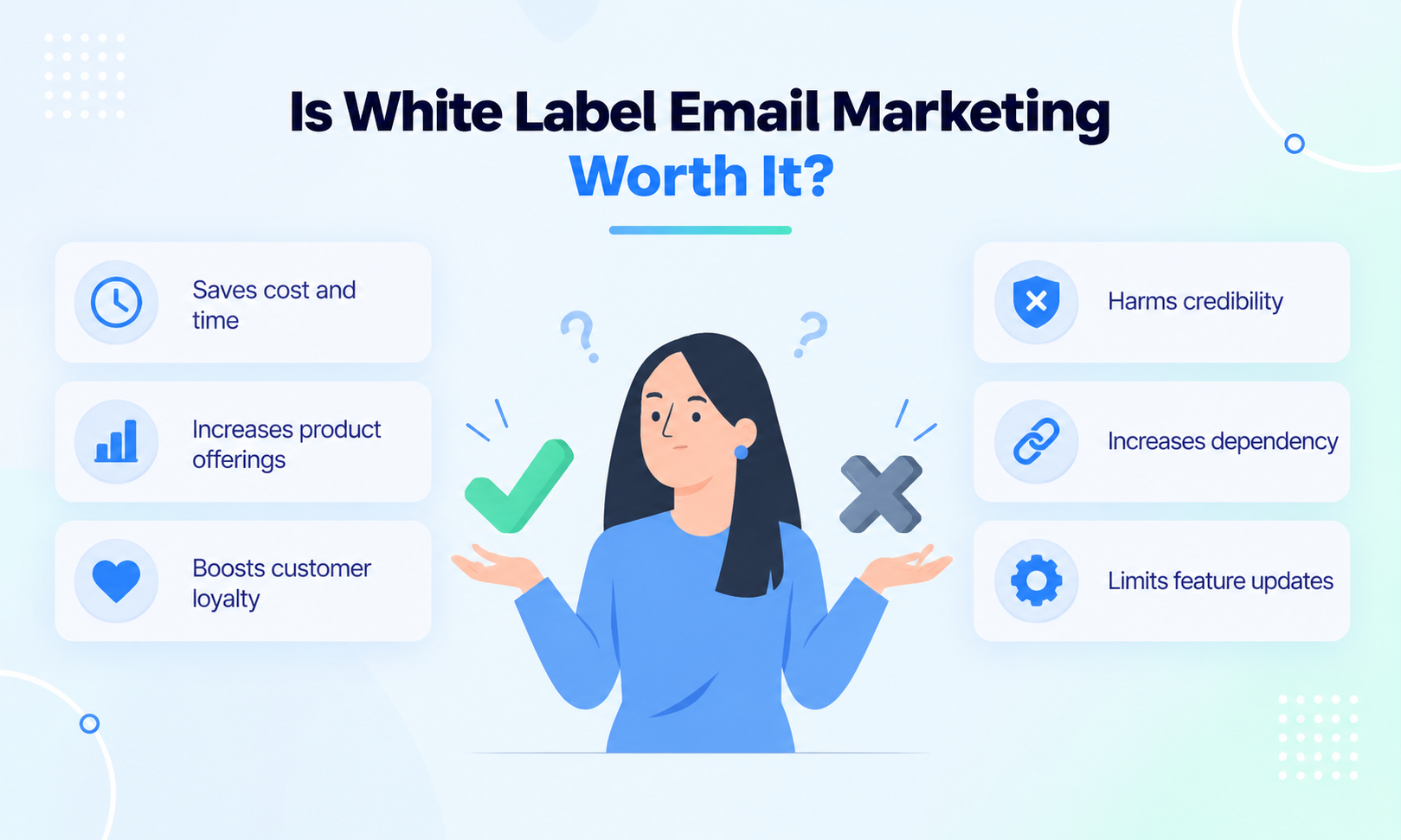
White label software is not necessarily the right choice for everyone.
If you are simply running email marketing for your own small business and have no plans to offer email marketing as a service, a traditional email marketing platform may be sufficient.
However, white label software becomes particularly interesting when you want to make email marketing part of your own offering.
Agencies can use white label email marketing to provide clients with a branded marketing platform while managing campaigns, automation, and reporting.
It can also help agencies move from selling individual services toward offering a more complete marketing technology solution.
A SaaS company may want to add email marketing functionality to its existing product without spending years developing email infrastructure, campaign builders, automation engines, analytics, and contact management systems.
A white label platform can provide a faster route to market.
Consultants who manage email marketing for multiple businesses can use a branded platform to create a more consistent client experience.
For businesses with an existing customer base, white label email software can create an additional product or revenue opportunity.
Instead of simply referring customers to another email marketing provider, the business can potentially offer email marketing under its own brand.
Companies managing multiple locations may also benefit from centralized email marketing infrastructure combined with individual branding, user management, segmentation, and automation.
If you are unsure whether you actually need white label software, consider the difference between the two models.
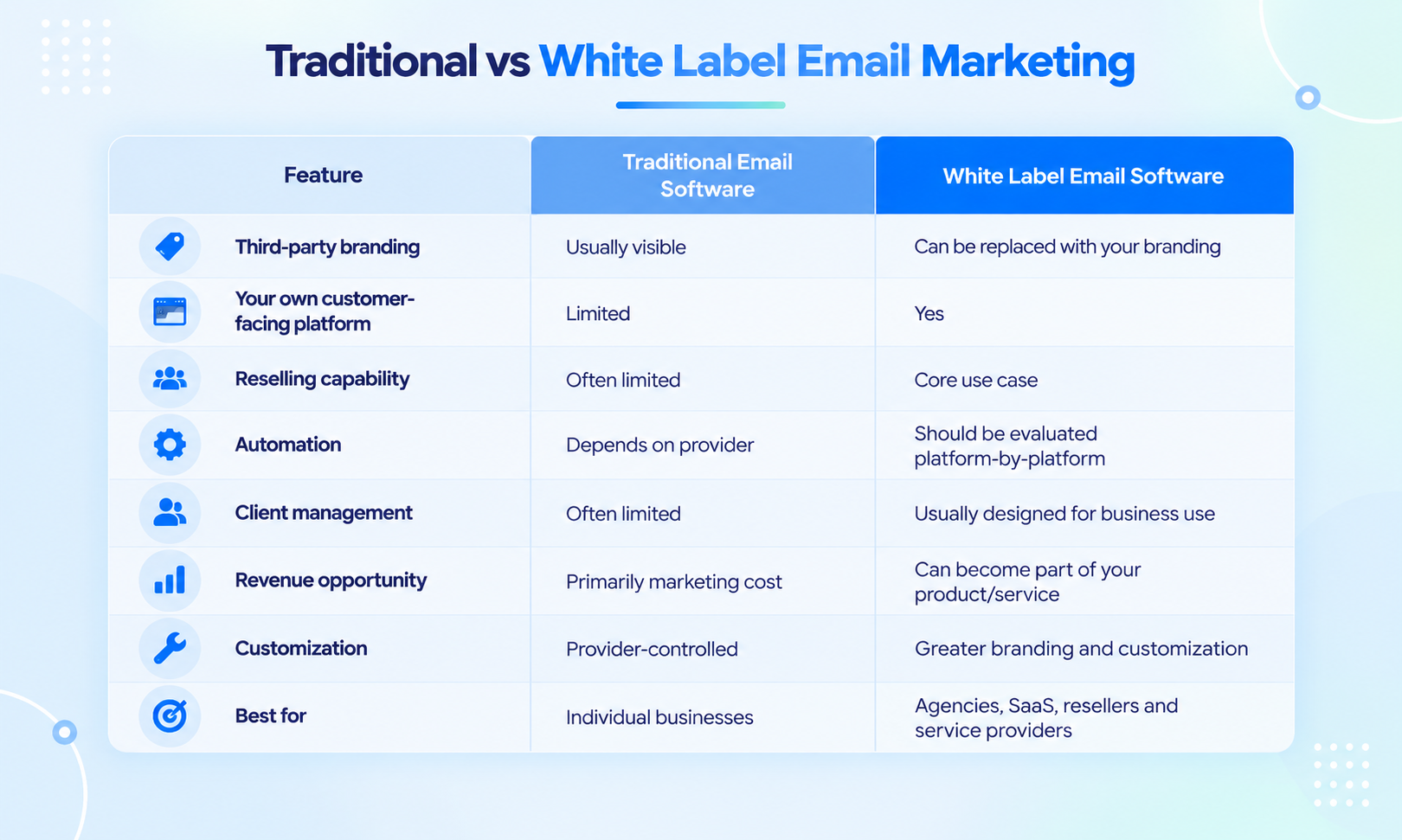
The key question is not whether white label software is "better."
The question is:
Do you want email marketing software for your company, or do you want to offer email marketing software as part of your company's own solution?
If the second option sounds closer to your business model, white labeling deserves serious consideration.
You do not necessarily need the most complicated automation system available.
The right level of automation depends on your business.
If you are new to email marketing, start with:
As your audience grows, consider:
More mature marketing teams may benefit from:
A good platform should allow you to start at one level and grow into the next without forcing you to migrate to another system.
A low monthly price does not necessarily mean better value.
Compare the features, contact limits, automation capabilities, integrations, support, scalability, and branding options before making a decision.
An autoresponder can send an email after a particular event.
Modern marketing automation can manage an entire customer journey based on multiple behaviors and conditions.
If automation is important to your business, look beyond basic autoresponders.
The platform that works for 1,000 contacts may not be ideal for 100,000 contacts.
Consider where your business could be in the next two to three years.
If your CRM, ecommerce platform, website, or sales system cannot communicate with your email software, you may end up doing unnecessary manual work.
Sending more emails does not automatically produce better results.
Your platform should provide the infrastructure and tools necessary to support responsible sending, authentication, list hygiene, and subscriber management.
One of the biggest reasons businesses explore all-in-one platforms is to reduce the complexity of managing several disconnected marketing tools.
If your requirements include lead capture, email campaigns, automation, contact management, and analytics, compare the cost and complexity of an integrated solution against purchasing each component separately.
Before signing up, ask these questions:
Can I completely brand the platform?
Make sure you understand exactly what can be customized.
Does it include genuine marketing automation?
Look for visual workflows, triggers, conditions, delays, branching, and behavioral automation rather than a basic autoresponder.
Can it integrate with my existing technology?
Check CRM, ecommerce, API, webhook, and third-party integration options.
Can my customers use the platform themselves?
If you are an agency or reseller, understand the user and account management experience.
Can the platform scale with my business?
Consider contact volumes, sending requirements, users, automation complexity, and future growth.
What analytics are available?
Make sure you can measure more than opens and clicks if you need to demonstrate ROI.
What happens to inactive or unsubscribed contacts?
List hygiene and suppression are important for long-term deliverability.
What support is available?
Technical support becomes especially important when the software is part of your own customer-facing offering.
Email marketing software has evolved significantly beyond sending newsletters.
Modern businesses need to capture leads, organize contacts, understand customer behavior, personalize communication, automate repetitive tasks, nurture prospects, recover lost sales, retain customers, and measure results.
If you are purchasing software only for your own email campaigns, a traditional email marketing platform may be enough.
But if you are an agency, SaaS company, consultant, reseller, franchise, or technology provider that wants to make email marketing part of your own offering, white label email marketing software with automation can provide considerably more flexibility.
The most important thing is to look beyond the words "white label" and "automation." A platform should give you meaningful branding capabilities, a reliable email marketing engine, visual automation workflows, segmentation, behavioral triggers, analytics, integrations, lead generation, and room to scale.
For businesses looking for a solution that brings these capabilities together, Mailmunch White Label is our first recommendation.
Its combination of white label branding, email marketing, visual automation, segmentation, lead generation, contact management, analytics, CRM and ecommerce integrations makes it a strong option for companies that want to offer a complete email marketing solution under their own brand.
The biggest advantage is not simply having more features.
It is having the ability to start with basic email campaigns and gradually build sophisticated automated customer journeys without rebuilding your marketing infrastructure from scratch.
If your goal is to turn email marketing into a scalable part of your business, that flexibility can make a significant difference.
Ready to explore a white label email marketing platform for your business? Explore Mailmunch White Label to see how you can combine branded email marketing, automation, lead generation, and analytics into one platform.
Ayesha Ejaz is a passionate writer who loves diving into research to explore new topics and broaden her knowledge. With a keen interest in learning through writing, Ayesha crafts informative and engaging content across various subjects. You'll find her unwinding with music or challenging herself with word search puzzles when she's not writing.
Tags:


