10 Best Mailerjet Alternatives for Email Marketing in 2026

Ayesha Ejaz Last updated on

If you’re searching for Mailerjet alternatives, you’re likely comparing features, pricing, automation depth, and scalability before committing to a long-term email marketing platform.
Email marketing remains one of the highest-ROI digital channels. But not all tools are built the same. As your list grows, your automation needs become more sophisticated, and your revenue increasingly depends on lifecycle marketing, the limitations of entry-level platforms become more noticeable.
In this comprehensive guide, we’ll break down:
- Why businesses look for Mailerjet alternatives
- What features actually matter in 2026
- Detailed comparisons of the top competitors
- Pricing and automation differences
- Which platform is best for your specific business model
Let’s begin.
Why Businesses Look for Mailerjet Alternatives
Mailerjet is positioned as a simple, lightweight email marketing solution. While that works for beginners, many businesses eventually need more depth.
Here are the most common reasons users search for alternatives:
1. Pricing Scalability
Entry-level plans often appear affordable. However, as your subscriber list grows, pricing tiers can increase significantly. Businesses scaling from 5,000 to 50,000 contacts may see sharp jumps in monthly costs.
When evaluating alternatives, long-term cost per subscriber becomes more important than entry pricing.
2. Automation Limitations
Basic autoresponders are no longer sufficient. Modern businesses require:
- Behavioral triggers
- Multi-branch workflows
- Conditional logic
- Event-based automation
- eCommerce revenue tracking
Platforms with shallow automation builders can restrict lifecycle marketing sophistication.
3. Limited eCommerce Features
If you're running an online store, you need:
- Abandoned cart automation
- Browse abandonment
- Product recommendations
- Revenue attribution
- Deep integration with platforms like Shopify and WooCommerce
Not all email tools handle these use cases well.
4. Segmentation Constraints
Advanced segmentation is essential in 2026. Static lists are outdated. You need:
- Dynamic audience segments
- Tag-based systems
- Real-time behavior filtering
- Purchase-based targeting
If segmentation is limited, personalization suffers.
What to Look for in a Mailerjet Alternative
Before jumping into comparisons, define evaluation criteria. A strong alternative should offer:
Advanced Automation Builder
Look for:
- Visual workflow editor
- Multiple triggers
- Split paths
- Goal tracking
- Automation templates
Integrated Lead Generation Tools
Some platforms only handle email. Others include:
- Popups
- Landing pages
- Embedded forms
- Lead magnets
- A/B testing
An all-in-one system reduces tech stack complexity.
Strong Deliverability Infrastructure
High open rates depend on:
- Dedicated IP options
- Authentication support (SPF, DKIM, DMARC)
- Reputation monitoring
- Deliverability reporting
Transparent Pricing
Avoid tools that heavily gate features behind higher tiers. Look for predictable cost scaling.
CRM & eCommerce Compatibility
Seamless data flow is critical. Choose platforms that integrate smoothly with your store or CRM system.
10 Best Mailerjet Alternatives in 2026
Below is a detailed breakdown of leading competitors.
1. Mailmunch
Best For: SMBs, eCommerce brands, agencies seeking an all-in-one solution
Mailmunch positions itself as a unified lead generation and email marketing platform. Unlike many tools that separate list building from email automation, Mailmunch integrates both into a single ecosystem.
Key Features
- Popups, embedded forms, landing pages
- Advanced segmentation
- Automation workflows
- eCommerce integrations
- Behavioral targeting
- Conversion-focused templates
Why It’s a Strong Mailerjet Alternative
Compared to Mailerjet, Mailmunch provides:
- More robust lead capture tools
- Integrated automation workflows
- Better eCommerce capabilities
- Competitive pricing at scale
If you want a platform that handles both acquisition and retention, Mailmunch offers more depth.
2. Mailchimp
Best For: Established brands and marketing teams
Mailchimp is one of the most recognizable names in email marketing.
Strengths
- Extensive template library
- Advanced automation
- Strong reporting
- Brand reputation
Limitations
- Pricing escalates quickly
- Many features restricted to higher tiers
- Complex UI for beginners
Compared to Mailerjet, Mailchimp offers stronger automation but at a higher long-term cost.
3. MailerLite
Best For: Simplicity and affordability
MailerLite is often chosen for its clean interface and budget-friendly plans.
Strengths
- Easy to use
- Solid automation builder
- Landing pages included
Limitations
- Limited enterprise features
- Reporting less advanced
MailerLite is a practical alternative for small businesses wanting simplicity without sacrificing automation basics.
4. Brevo
Best For: Multi-channel marketing
Brevo combines email, SMS, and CRM functionality.
Strengths
- SMS marketing
- Transactional email
- CRM included
- Competitive pricing
Limitations
- Automation builder less intuitive
- UI can feel dense
Brevo is suitable for businesses needing multi-channel communication.
5. GetResponse
Best For: Funnel-based marketers
GetResponse stands out for its:
- Conversion funnels
- Webinar hosting
- Advanced autoresponders
It’s a strong option for digital marketers who run launches or webinar-driven campaigns.
6. ActiveCampaign
Best For: Advanced automation and CRM-driven marketing
ActiveCampaign is one of the most powerful automation platforms available.
Strengths
- Deep conditional workflows
- Built-in CRM
- Predictive sending
- Lead scoring
Limitations
- Higher pricing
- Learning curve
If automation sophistication is your top priority, ActiveCampaign surpasses many alternatives.
7. ConvertKit
Best For: Creators and online educators
ConvertKit focuses on:
- Tag-based subscriber systems
- Creator monetization tools
- Digital product sales
It is particularly effective for newsletter creators and course sellers.
8. Moosend
Best For: Budget-conscious automation
Moosend offers:
- Affordable pricing
- Automation workflows
- Reporting dashboards
It’s a cost-effective alternative without excessive complexity.
9. Constant Contact
Best For: Beginners and nonprofits
Constant Contact emphasizes ease of use and customer support.
Strengths
- Simple campaign builder
- Event management tools
- Strong support
Less suited for advanced automation needs.
10. HubSpot Email Marketing
Best For: Enterprise-level marketing ecosystems
HubSpot integrates email marketing within a full CRM suite.
Strengths
- Deep CRM integration
- Sales pipeline visibility
- Advanced attribution
Limitations
- Expensive
- Overkill for small teams
Mailerjet vs Top Alternatives: Feature Comparison
Automation Depth
- Basic: Mailerjet
- Moderate: MailerLite, Moosend
- Advanced: Mailmunch, GetResponse
- Enterprise-grade: ActiveCampaign, HubSpot
If your revenue depends on lifecycle marketing, choose tools with behavioral triggers and conditional branching.
Pricing at Scale
While pricing varies, general trends show:
- Budget-friendly: Moosend, MailerLite
- Mid-range value: Mailmunch, Brevo
- Premium: Mailchimp, ActiveCampaign, HubSpot
When evaluating, calculate cost per 1,000 subscribers at projected list size — not just entry tier.
eCommerce Capabilities
For online stores, prioritize:
- Cart abandonment
- Revenue attribution
- Product sync
- Dynamic content blocks
Mailmunch, ActiveCampaign, and GetResponse perform well in eCommerce workflows.
Ease of Use
If your team lacks technical marketers:
- Most intuitive: MailerLite, Constant Contact
- Moderate learning curve: Mailmunch, GetResponse
- Steeper learning curve: ActiveCampaign, HubSpot
Pros and Cons of Switching from Mailerjet
Pros
- More advanced automation
- Better segmentation
- Improved integrations
- Scalable pricing structures
- Expanded revenue tracking
Cons
- Migration effort
- Rebuilding workflows
- Domain reauthentication
- Learning new interface
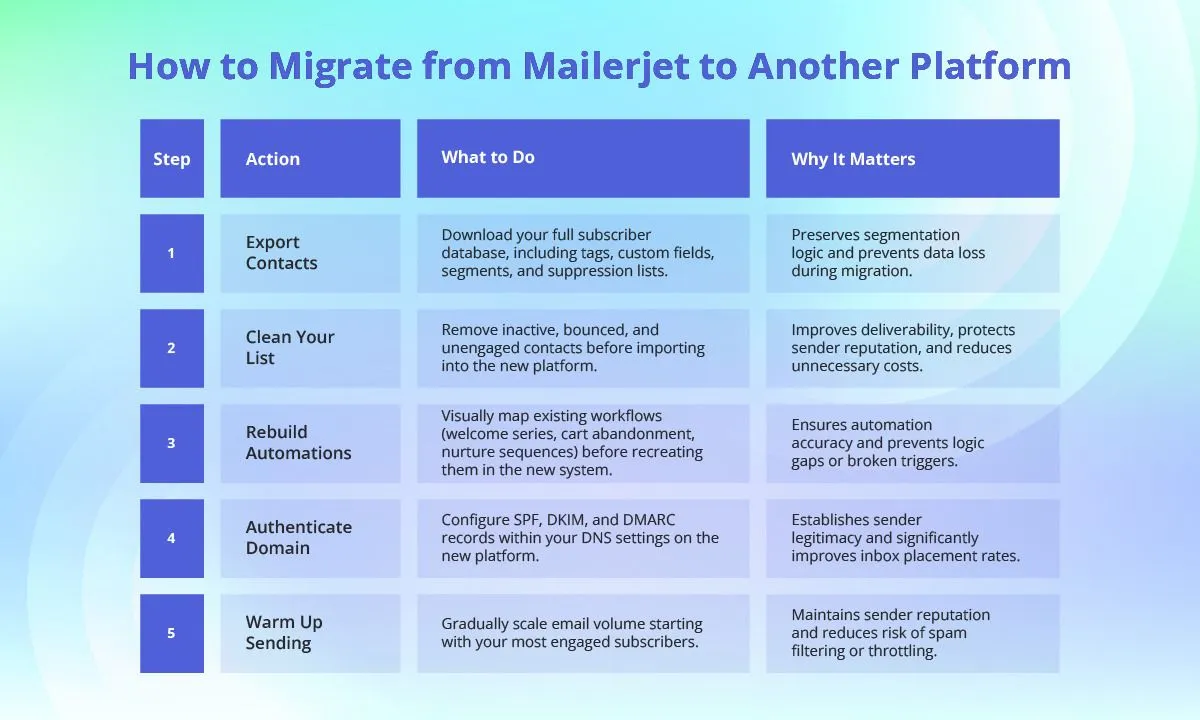
Switching requires planning but can significantly increase ROI if your current tool limits growth.
How to Migrate from Mailerjet to Another Platform
Final Verdict: Choosing the Right Mailerjet Alternative
The best Mailerjet alternative depends entirely on your growth stage and operational complexity.
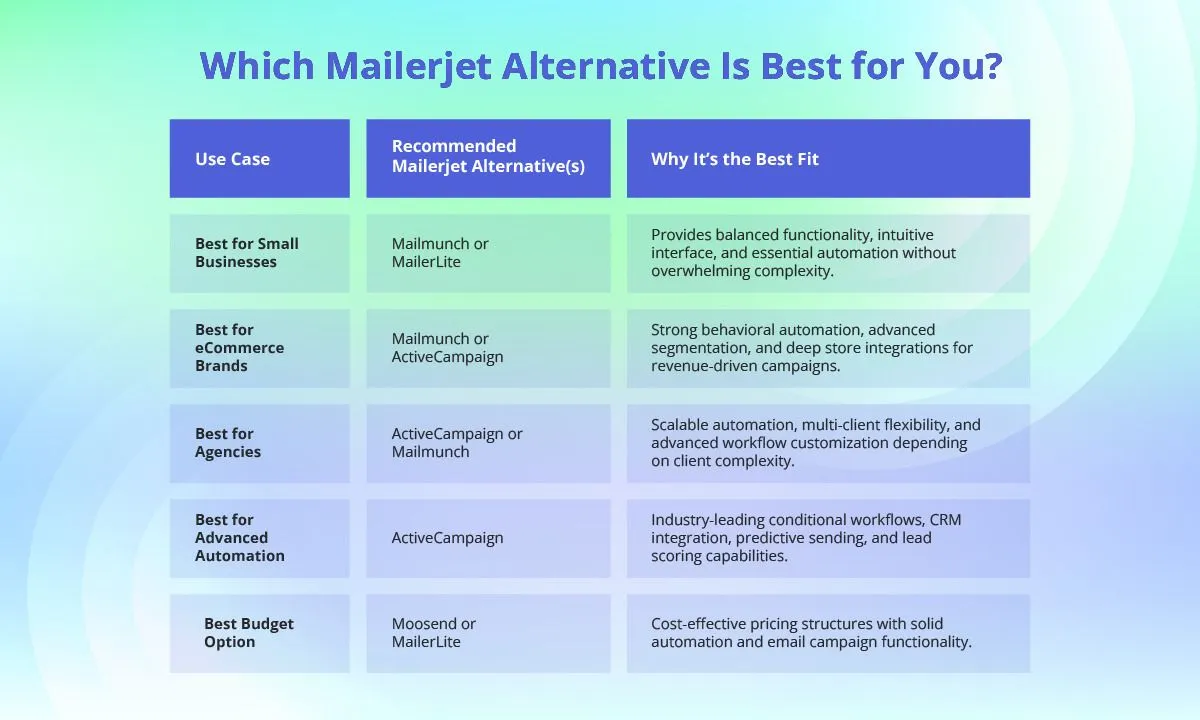
- If you want an all-in-one lead generation and email marketing platform, Mailmunch is a strong contender.
- If you prioritize advanced automation logic, ActiveCampaign is the most powerful option.
- If simplicity and cost control matter most, MailerLite or Moosend are practical choices.
- If you need a complete CRM ecosystem, HubSpot delivers enterprise-level integration.
Email marketing in 2026 is no longer just about sending newsletters. It’s about lifecycle automation, behavioral personalization, and revenue attribution.
Choose the platform that aligns with your growth trajectory not just your current list size.